Zero Per Unit Cost or Secure Tap: QR Codes vs NFC for Project Teams
Zero Per Unit Cost or Secure Tap: QR Codes vs NFC for Project Teams
Use NFC for secure, in-hand interactions where speed and authentication matter, like payments, access badges, and premium tap-to-share. Use QR codes for anything that needs to reach a crowd from a distance at close to zero cost per unit, like menus, posters, and product packaging. When you can’t decide, run both: QR as the universal fallback everyone can scan, NFC as the faster, more secure option for people whose phones support it.
TL;DR:
- NFC is ideal for secure, quick in-hand interactions like payments and access, but its short range limits use for distance or large displays.
- QR codes are cheaper at scale, easily visible from afar, and require no embedded hardware, making them suitable for posters, menus, and broad outreach.
- Hardware costs and environmental durability favor QR codes for volume printed materials, while NFC’s security features benefit anti-counterfeit and authentication needs.
- Device support for QR codes is nearly universal, whereas NFC support varies, especially on older or budget phones, requiring testing before deployment.
- Hybrid solutions pairing both technologies are common in premium products, using QR for general info and NFC for authentication or secure interactions.
Table of Contents
- QR Codes Vs NFC: A Head-to-Head Comparison
- How Does NFC Work Compared to QR Codes?
- Which Technology Fits Which Everyday Use Case?
- What Does It Cost to Deploy QR Codes or NFC?
- Which Carrier Is More Secure and Privacy-Friendly?
- How Do You Choose Between QR Codes and NFC?
- Getting QR Implementation Right in Practice
- The Practical Default for Most Projects
- How Rdyrct Makes QR and NFC Tracking Easier
- Sources
- FAQ
QR Codes Vs NFC: A Head-to-Head Comparison
The two technologies solve overlapping problems in almost opposite ways. QR codes are optical, printable, and free to reproduce once designed. NFC is a radio handshake that needs a chip embedded in a physical object and a phone held within a couple of inches of it.
That difference in physical form drives everything else. A QR code scales with distance. A one-inch code is readable from roughly 10 feet away, and a billboard-sized version works across a parking lot, following the empirical 10:1 size-to-distance rule that print designers rely on. NFC can’t do that trick at any size. It’s capped at a few centimeters no matter how large the tag is, because the read range comes from radio induction, not optics.
Interaction friction cuts the other way. Scanning a QR code means unlocking your phone, opening the camera, framing the code, and waiting for to decode. NFC just needs a tap, and the phone often reacts before you’ve fully touched the surface. For anyone who has fumbled with a restaurant’s tiny table code in bad lighting, that speed difference is obvious.
Here’s how the two stack up across the dimensions that actually decide a project:
- Interaction model: QR requires camera framing and a decode step; NFC requires only proximity and often triggers automatically on unlock.
- Range and visibility: QR scales with print size and works at a distance; NFC works only within a few centimeters, regardless of tag size.
- Cost at scale: QR printing cost is effectively zero once designed; NFC needs a physical chip per unit, so cost scales with volume.
- Device support: Nearly every modern smartphone camera reads QR codes natively; NFC support exists on most current phones but historically lagged on some budget Android models and required extra taps on older iPhones.
- Analytics and updates: A dynamic QR code lets you swap the destination without touching the printed code; reprogramming an NFC tag usually needs physical access to the chip unless it was set up for redirect based tracking.
Platform quirks matter more than people expect. iOS has read QR codes natively through the camera app since iOS 11, and NFC reads happen automatically in the background for many tag types since iOS 14. Android behavior varies more by manufacturer and skin, which is one reason testing on actual target devices before a big print run or hardware order saves real money.
How Does NFC Work Compared to QR Codes?
NFC and QR codes come from completely different engineering families, and that’s worth understanding before you commit budget to either one.
NFC runs on radio. It operates at 13.56 MHz and supports three modes: card emulation (the phone acts like a contactless card, used in tap-to-pay), reader/writer mode (the phone reads data off a passive tag), and peer-to-peer (two active devices exchange data directly). Data on passive tags is stored in NDEF format, a standardized envelope that can hold a URL, plain text, or a phone number.
Not all NFC tags are equal. The differences matter for anyone actually buying hardware:
- NTAG213: smallest memory (about 144 bytes usable), cheapest, fine for a simple URL redirect.
- NTAG215: middle tier, often used in gaming and loyalty applications needing slightly more storage.
- NTAG216: largest standard memory, useful when you need to store more than a link.
- NTAG424 DNA: built for security, generates a unique cryptographic signature on every tap, which is what makes authenticated anti-counterfeit tags possible.
Typical read range across all of these sits at a few centimeters, tight enough that accidental reads are rare and deliberate skimming from a distance is close to impossible, a point the NFC Forum treats as a defining feature rather than a limitation.
QR codes run on optics. A QR code is a two-dimensional matrix of black and white squares that a camera decodes using error-correction math built into the standard, which is why a code with a torn corner or a logo overlay usually still scans. There are two functional categories, not just two formats: static codes encode the destination directly and can never change, while dynamic codes point to a short redirect link that you control after printing.
Capacity is generous but rarely the limiting factor. A QR code can hold thousands of alphanumeric characters, though anything encoding a full destination URL directly (a static code) locks you into that exact address forever. That’s the practical reason most working QR deployments use a dynamic short link instead of a raw URL: swap the destination behind the link and every already-printed code updates instantly.
The 10:1 heuristic is worth repeating because it governs real-world placement: a one-inch code scans from about 10 feet, so a code meant to be read from across a store aisle needs to be printed proportionally larger. NFC has no equivalent scaling option, since physics caps its range regardless of chip size.
Which Technology Fits Which Everyday Use Case?
Most real decisions come down to matching the interaction model to the environment. Here’s how that plays out across the situations you’re most likely to actually run into.
- Payments and transit. NFC wins outright. Contactless card and mobile wallet payments use secure element hardware and tokenization, and Stripe’s own comparison notes NFC is generally the faster, more secure choice for in-person transactions, with QR serving mainly as a low-cost supplement in specific app-driven flows like some transit systems and street vendors.
- Menus, posters, and billboards. QR wins without much debate. You’re printing something once for hundreds or thousands of viewers, distance matters, and the marginal cost per additional viewer is zero. Nobody’s tapping their phone on a billboard.
- Product packaging and authenticity checks. This is where hybrid deployments earn their keep. A visible QR code handles general product information for anyone who scans it, while an embedded NFC chip, often an authenticated NTAG424 DNA tag, verifies the item is genuine on tap. Seventeen years of field deployments show this pairing is now standard in premium retail and pharmaceuticals.
- Events and networking. NFC shines for fast contact exchange, tapping business cards or badges to swap details in under a second, while QR still dominates event ticketing and public wayfinding because it doesn’t require dedicated hardware on the check-in side.
- Smart-home and local automation. NFC tags placed near a door or nightstand can trigger a phone shortcut (turn on lights, start a playlist) with a tap, a use case QR can technically replicate but with more friction since it requires opening a camera first.
The pattern across all five: NFC wins when the interaction is personal, secure, or repeated by the same person; QR wins when the interaction is public, one-off, or needs to reach people at a distance.
What Does It Cost to Deploy QR Codes or NFC?
Cost is usually the deciding factor once the use case is settled, and the gap between the two technologies is bigger than most people assume.
QR code printing carries no per-unit hardware cost. Once you’ve designed the code, adding it to a menu, a flyer, or ten thousand product boxes costs whatever your printer already charges for ink and paper. There’s no chip, no embedding labor, nothing to source. That’s the entire economic case for QR at scale.
NFC tags are physical components, and pricing varies by chip type:
- NTAG213 tags: the cheapest tier, often available in bulk at low per-unit cost, suited to simple link redirects.
- NTAG215/216 tags: modestly more expensive, chosen when you need more onboard memory.
- NTAG424 DNA tags: the priciest tier because of the added cryptographic authentication, justified only when counterfeit protection or verified taps matter.
Beyond the sticker price on the chip itself, factor in the labor to physically embed each tag into packaging, a card, or a sticker, plus environmental durability. A laminated QR code on a metal sign shrugs off weather for years. An NFC tag exposed to repeated flexing, moisture, or extreme heat can degrade or detach faster, especially cheaper adhesive-backed variants.
Total cost of ownership tends to favor QR for anything printed in volume: posters, packaging inserts, table tents. NFC’s added cost only pays for itself when the tap experience or the authentication layer solves a problem QR genuinely can’t, like verifying a product hasn’t been swapped or counterfeited. That’s also why hybrid labels pairing both technologies on one item have become common in premium goods: you pay the NFC premium only where it earns its keep, while QR covers everyone else for free.
Which Carrier Is More Secure and Privacy-Friendly?
Security works in NFC’s favor by default, and it comes down to physics rather than clever engineering. Because a read requires the phone to be within a few centimeters of the tag, opportunistic skimming from across a room is essentially impossible, an advantage the NFC Forum treats as a core design feature rather than a bonus. Authenticated tags like NTAG424 DNA push this further by generating a unique cryptographic signature on every tap, so even a cloned physical tag produces a different, invalid code.
The remaining NFC risk is the relay attack, where a compromised reader forwards a legitimate tag’s signal over the internet to a distant accomplice. It’s a real threat in payment fraud research, though it requires far more coordination than the risks facing QR codes.
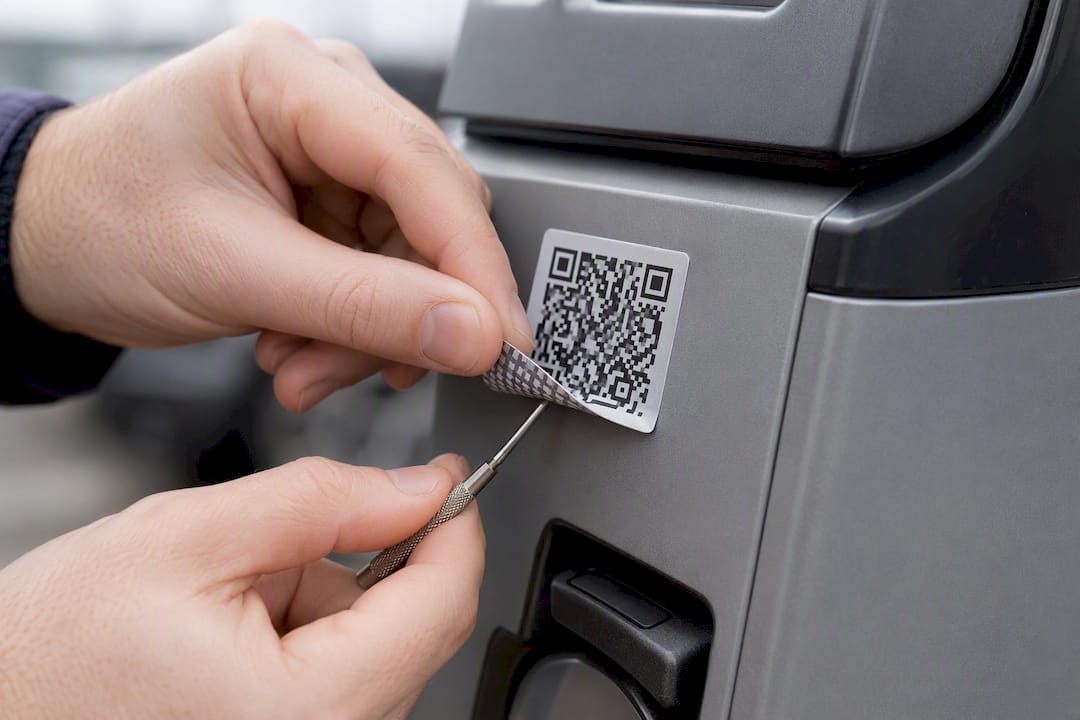
QR codes face a more mundane but more common problem: physical tampering. Anyone can print a sticker with a malicious code and paste it over a legitimate one on a parking meter or restaurant table, a scam sometimes called “quishing.” Mitigation is straightforward but requires discipline: use a recognizable branded QR design so a swapped code looks visibly wrong, run periodic physical audits of high-traffic codes, and route every code through a signed short link you control rather than a raw destination URL, so you can kill or redirect a compromised code instantly.
Privacy deserves equal attention on both sides. Every tap or scan generates a data point, and how you handle that data matters. Redirect based tracking through a short link lets you capture campaign, device, and referrer information without storing IP addresses tied to individual visitors, which keeps you closer to privacy-first practice than logging raw request data.
Pro Tip: Before any large print run or hardware order, physically audit five random QR placements in the field. If even one looks easy to peel and replace, switch to tamper-evident stickers or add a small printed brand mark that’s hard to forge convincingly.
How Do You Choose Between QR Codes and NFC?
Work through these five checks before committing budget to either technology.
- Check your audience’s devices. If you can’t guarantee NFC support or comfort using it, especially with older or budget Android phones, default to QR since virtually every camera can read it.
- Estimate your volume and budget. High-volume printed material (thousands of units) almost always favors QR because per-unit hardware cost disappears entirely.
- Define your security requirement. If you need proof the physical item wasn’t swapped or cloned, that’s a job for NFC, ideally an authenticated tag type.
- Measure your distance and visibility need. Anything meant to be seen and scanned from more than a couple of feet away rules out NFC immediately.
- Pilot before you scale. Print a small batch or order a handful of tags, track scans and taps through a dynamic short link, and see which one your actual audience uses before locking in thousands of units.
The default pattern that works for most everyday projects: go QR-only for high-volume printed material where cost per unit rules the decision, and add NFC only where the tap experience or anti-counterfeit layer solves a problem QR genuinely can’t touch. Measure everything through consistent tracking so the pilot data, not a hunch, decides the rollout.
Getting QR Implementation Right in Practice
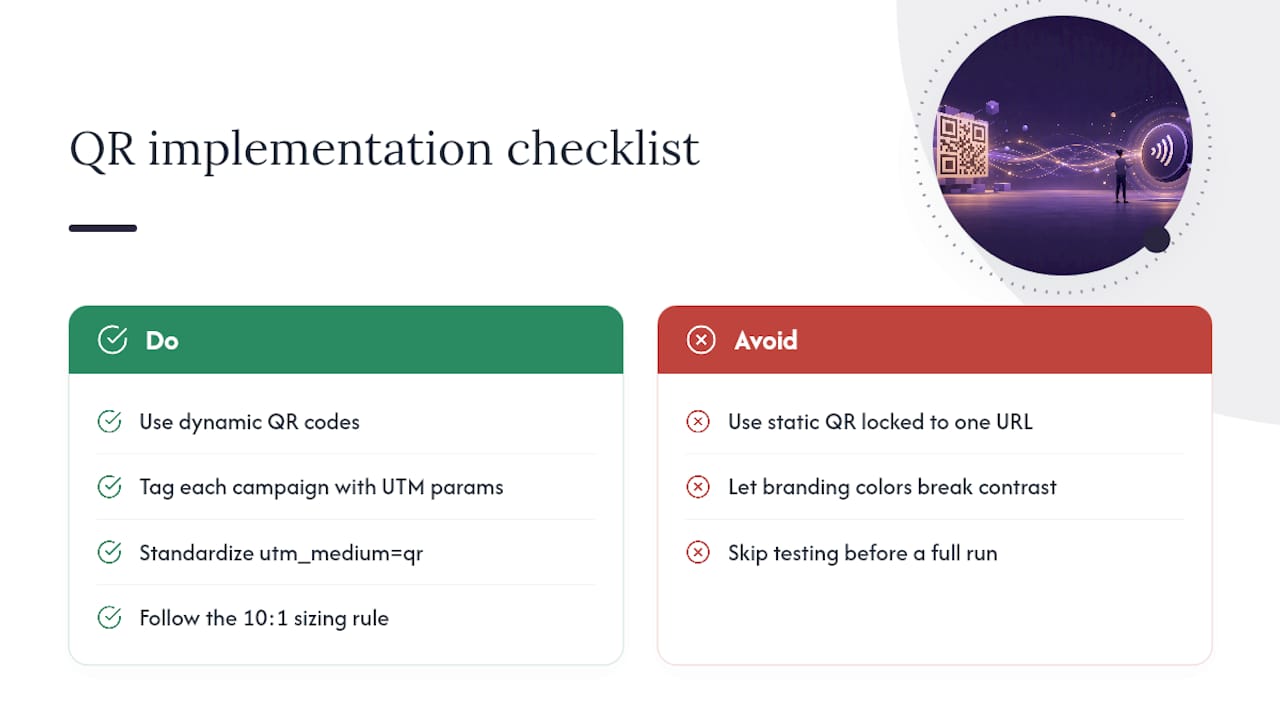
A static QR code locked to one destination is a liability the moment your menu changes or your campaign URL needs updating. Dynamic QR codes solve that by pointing to a short link you can redirect anytime, so the printed code never needs reprinting.
Tag every QR campaign with consistent UTM parameters, and standardize on utm_medium=qr so scan traffic never gets lumped in with regular website visits in your analytics. Follow the 10:1 sizing rule when placing codes: a one-inch code needs roughly 10 feet of scan distance, so size accordingly for posters versus table cards. Keep contrast high between the code and its background, since heavy branding colors can break scannability if you’re not careful with your design choices, and always test a printed proof with three or four different phone models before a full run. Treat every scan as the start of a relationship worth designing for, not just a click to count.
The Practical Default for Most Projects
My honest read after weighing the technical constraints against real deployment costs: default to a universal QR code for anything printed at volume, and layer in NFC only where the tap experience or authentication genuinely earns its extra cost per unit. Most everyday projects, menus, business cards, event signage, don’t need NFC’s precision.
Treat every scan and every tap as a measurable event, not just a nice-to-have feature. Prioritize privacy-preserving analytics over invasive tracking, and run a small pilot before ordering NFC hardware in bulk. The data from that pilot will tell you more than any spec sheet.
— Andrea
How Rdyrct Makes QR and NFC Tracking Easier
Rdyrct is the alternative to guessing whether your QR campaign is actually working. Every code you generate through Rdyrct’s free QR code generator is built on a dynamic short link, so you can change the destination anytime without reprinting a single sticker or menu.

That same link gives you privacy-first analytics: country, referrer, and device breakdowns on every scan, without ever storing visitor IP addresses. You get real campaign data, not invasive tracking. Whether you’re running one QR code on a storefront window or coordinating dozens across a product line, Rdyrct’s Free plan costs nothing to start, and the Hobby and Pro tiers unlock branded codes, custom domains, and longer analytics history as your volume grows. Start by generating your first branded QR code and watch the scan data roll in.
Sources
For the technical fundamentals behind NFC, the NFC Forum’s technology overview and its explainer on NFC use cases are the primary standards references. For deployment economics and cost comparisons, see the 17-year deployment analysis from QRCodeKIT and EZQR’s technical cost breakdown. Accessibility considerations, including multilingual QR content, are covered by Live Caption AI.
- NFC Forum — Learn: NFC technology
- The difference between NFC and QR code payments — Stripe
- QR codes vs NFC vs RFID: what 17 years of deployments actually show • QRCodeKIT
- QR codes are a direct line to your customer—now what? — Forbes
FAQ
Which Is Better, NFC or QR Code?
Neither wins universally. NFC is better for secure, fast, in-hand interactions like payments and access control, while QR is better for reaching people at a distance with zero per-unit cost, and many deployments now use both on the same item.
Do I Really Need NFC on My Phone?
Not for most daily tasks, since QR codes cover menus, tickets, and marketing links with just a camera. NFC becomes valuable specifically for contactless payments, transit cards, and tapping smart tags, so it’s worth having but rarely a strict requirement.
What Are the Drawbacks of NFC?
Its short range, a few centimeters at most, means it can’t be scanned from a distance or displayed on a poster, and per-unit tag costs add up fast across large print or product runs. It’s also more vulnerable to relay attacks than to casual skimming.
What Is the Disadvantage of QR Code Payment?
QR payments generally lag behind NFC on speed and security for in-person transactions, since NFC’s tokenized secure element is purpose-built for that job. QR codes are also more exposed to physical tampering, since a fraudulent sticker can be pasted over a legitimate code.