The Best Flowcode Alternatives for Scalable QR Programs
The Best Flowcode Alternatives for Scalable QR Programs

If you need more than two dynamic QR codes and a 500-scan ceiling, Flowcode’s free tier runs out fast. The strongest alternatives right now are Rdyrct (privacy-first, no IP storage, branded short links), Uniqode (enterprise analytics and SOC 2 compliance), Bitly (familiar link management with QR support), QR Tiger (retargeting pixels and bulk creation), QR Code Generator PRO (generous free dynamic tier), QR.io (clean UI with solid team features), and QRCode Monkey (free static design with high visual customization).
Here is the shortlist at a glance:
- Rdyrct — Best for privacy-conscious marketers who need branded QR codes, short links, and analytics without storing any IP addresses
- Uniqode (formerly Beaconstac) — Best for enterprise teams needing deep analytics, SOC 2 compliance, and CRM integrations
- Bitly — Best for teams already using Bitly for link management who want QR codes bundled in
- QR Code Generator PRO — Best free dynamic QR tier for small teams testing campaigns before committing to a paid plan
- QR Tiger — Best for performance marketers who need retargeting pixels and bulk CSV creation
- QR.io — Best for mid-size teams that want a clean dashboard, custom domains, and role-based access
- QRCode Monkey — Best for one-off static QR designs when visual branding matters more than analytics
Table of Contents
- Why marketing teams move away from Flowcode
- Vendor snapshots: which platform fits your program?
- Side-by-side feature comparison
- How to choose the right QR-code platform for your program
- Practical migration steps when moving off Flowcode
- Pricing and free-tier limits at a glance
- Privacy-first analytics: why it matters and how Rdyrct differs
- Key Takeaways
- Why the privacy argument for QR platforms is stronger than most guides admit
- Rdyrct gives you privacy-compliant QR codes and short links without the trade-offs
- Further reading and sources
Why marketing teams move away from Flowcode
The most common reason teams start searching for QR code alternatives is hitting Flowcode’s free-tier ceiling before a campaign even launches. Flowcode’s free plan includes 2 dynamic QR codes and a 500-scan cap, which is enough for a quick proof of concept but not for any real campaign with printed collateral. Once you cross that threshold, the paid tier starts at a monthly fee, and API access sits behind higher-tier plans entirely.

Beyond the scan cap, branding is a recurring friction point. G2 reviews consistently flag that Flowcode’s free and lower-paid tiers include watermarks on generated codes, which is a problem for any brand that cares about presenting a polished, white-labeled experience. White-labeling and custom domains are gated features, not defaults.

Integration depth is the third driver. Marketing teams running multi-channel programs need their QR platform to talk to their CRM, push scan data into Google Analytics or HubSpot, and fire retargeting pixels. Flowcode’s integrations are limited at lower price points, and teams that need webhook support or a documented REST API often find themselves priced into an enterprise tier they cannot justify for a single campaign.
Dynamic QR codes are the baseline requirement for any campaign with printed assets. They let you update the destination URL after the code is already on a flyer, a product package, or a billboard. A static code is permanent. If you print 10,000 brochures with a static QR and the landing page URL changes, every one of those brochures becomes a dead end. That single distinction is why most marketing teams should default to dynamic codes, and why a platform that limits dynamic codes on its free tier is a poor fit for anything beyond a one-time test.
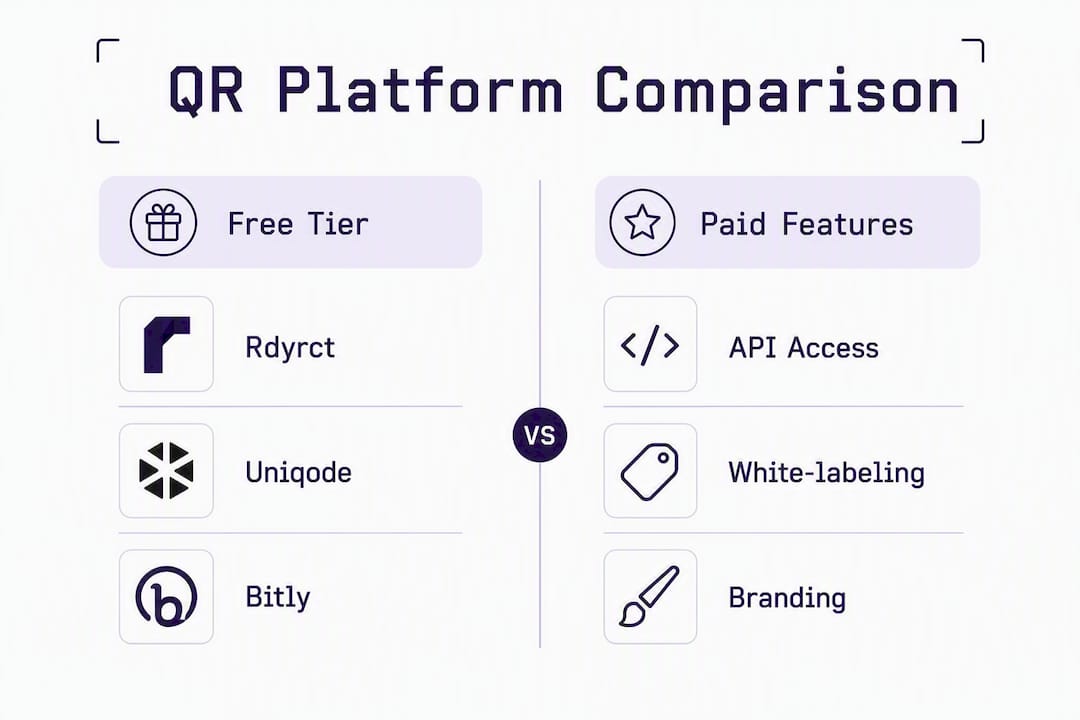
Vendor snapshots: which platform fits your program?
1. Rdyrct
Rdyrct is a privacy-first URL shortening and QR code platform that generates branded short links and customizable QR codes while explicitly not storing IP addresses. It delivers referrer, device, and geo analytics in real time without collecting personally identifiable information.
Best for: Marketing teams and developers who need privacy-compliant analytics, branded QR codes, and short links under a single platform.
- No IP address storage; analytics cover referrer, device type, and country without PII
- Branded short links and custom domains available on paid tiers
- API access, team roles, and organization management for collaborative campaigns
- Open-source self-hosted option on Cloudflare for teams with data-sovereignty requirements
Cons: Fewer out-of-the-box visual QR design templates than design-focused tools; advanced features require a paid plan.
Free tier: Free forever plan available; branded QR codes and custom domains unlock on paid plans.
2. Uniqode (formerly Beaconstac)
Uniqode is an enterprise-grade QR platform with deep analytics, CRM integrations, and published SOC 2 Type II and HIPAA compliance certifications. It targets retail, hospitality, and healthcare marketing teams that need audit trails and data governance.
Best for: Enterprise teams with compliance requirements and high scan volumes across multiple locations.
- SOC 2 Type II and HIPAA compliance documentation published
- Bulk QR creation, role-based access, and multi-location management
- Native integrations with Salesforce, HubSpot, and Google Analytics
Cons: Pricing reflects the enterprise positioning; overkill for small teams or solo marketers. Free tier is limited.
3. Bitly
Bitly is the most recognized name in link shortening and added QR code generation as a natural extension of its core product. If your team already manages branded short links in Bitly, the QR feature is a low-friction add-on.
Best for: Teams already invested in Bitly’s link management ecosystem who want QR codes without adopting a separate platform.
- Established brand trust and a large user base
- Custom domains and branded links on paid plans
- Basic scan analytics included
Cons: QR features are secondary to link management; analytics depth is shallower than dedicated QR platforms. Free tier is restrictive on branded links.
Pro Tip: If you are evaluating Bitly purely for QR codes, compare its per-QR pricing against dedicated platforms before committing. The bundled value only makes sense if you are already paying for Bitly’s link management.
4. QR Code Generator PRO
QR Code Generator PRO (qrcode-generator.com) offers one of the more accessible free dynamic QR tiers among the platforms reviewed here, making it a practical starting point for small teams that want to test dynamic codes before paying.
Best for: Small teams and solo marketers who need free dynamic QR codes with basic analytics and no immediate budget.
- Free dynamic QR codes available without a credit card
- Clean, straightforward interface with basic customization
- Scan analytics on free tier
Cons: Advanced features like API access, white-labeling, and deep analytics require paid plans. Brand customization options are more limited than design-focused tools.
5. QR Tiger
QR Tiger targets performance marketers with features like retargeting pixels, bulk QR creation via CSV upload, and a range of QR types (URL, vCard, WiFi, social media). It sits in the mid-market tier with a feature set that competes with enterprise tools at a lower price point.
Best for: Performance marketers running multi-channel campaigns who need retargeting and bulk creation.
- Retargeting pixels and white-labeling as mid-tier features
- Bulk CSV creation for large-scale QR deployment
- Custom domains and branded codes on paid plans
Cons: The interface can feel cluttered when managing large QR libraries. Free tier scan limits apply.
6. QR.io
QR.io is a mid-market platform with a clean dashboard, custom domain support, and role-based team access. It covers the core dynamic QR use case well and adds folder organization for teams managing multiple campaigns simultaneously.
Best for: Mid-size marketing teams that need organized campaign management and custom domains without enterprise pricing.
- Custom domains and branded QR codes
- Team roles and folder-based campaign organization
- Dynamic QR codes with scan analytics
Cons: Integration depth is narrower than Uniqode; no published SOC 2 or HIPAA compliance documentation.
7. QRCode Monkey
QRCode Monkey is a free, design-focused static QR generator. It produces high-resolution QR codes with extensive visual customization, including logo embedding and color gradients, and exports in SVG and PNG formats.
Best for: Designers and marketers who need a one-off, visually polished static QR code with no ongoing subscription.
- Free high-resolution SVG and PNG exports
- Logo embedding and color customization
- No account required for basic use
Cons: Static codes only on the free tier; no analytics, no dynamic redirect support, no team features.
Side-by-side feature comparison
| Feature | Rdyrct | Uniqode | Bitly | QR Code Generator PRO | QR Tiger | QR.io | QRCode Monkey |
|---|---|---|---|---|---|---|---|
| Best for | Privacy-first branded links + QR | Enterprise compliance + analytics | Link management teams | Free dynamic QR testing | Performance/retargeting | Mid-market team campaigns | One-off static designs |
| Dynamic QR support | Yes | Yes | Yes | Yes (free tier) | Yes | Yes | Paid only |
| Analytics depth | Referrer, device, country (no PII) | Deep: geo, device, CRM sync | Basic scan counts | Basic | Advanced + retargeting pixels | Moderate | None (static) |
| Privacy & PII policy | No IP storage; privacy-first | SOC 2 Type II, HIPAA | Standard data practices | Standard | Standard | Standard | No analytics collected |
| Integrations & API | API + webhooks; Cloudflare self-host | Salesforce, HubSpot, GA; API | API available | Limited | API on paid plans | Limited | None |
| Branded codes / custom domain | Yes (paid) | Yes | Yes (paid) | Limited | Yes (paid) | Yes | Logo embed only |
| Scan limits / rate caps | Per plan; free tier available | Per plan | Per plan | Free dynamic tier available | Per plan | Per plan | N/A (static, no tracking) |
| Bulk / team features | Team roles, org management | Multi-location, bulk, roles | Team plans | Limited | Bulk CSV, team plans | Folder org, roles | None |
| Pricing / free tier | Free forever plan; paid unlocks more | Paid-first; limited free | Free with restrictions | Free dynamic QR available | Free tier; paid from mid-range | Free tier available | Free (static only) |
| Link / QR health monitoring | Link health + activity monitoring | Uptime alerts on enterprise plans | Basic link status | Not listed publicly | Not listed publicly | Not listed publicly | None |
Flowcode free-tier reference: 2 dynamic QR codes, 500-scan cap, paid plans from $25/month per Flowcode support.
If your primary concern is data sovereignty and PII avoidance, the Privacy & PII column narrows the field to Rdyrct and QRCode Monkey quickly. Rdyrct is the only option that combines no-IP-storage analytics with dynamic codes, branded links, and an API. If you need SOC 2 or HIPAA documentation for a regulated industry, Uniqode is the clear answer despite its higher price point.
How to choose the right QR-code platform for your program
The single most important question is whether you need dynamic codes. If yes, your vendor must support editable redirects, and you must verify what happens to those redirects if you cancel your subscription. Some vendors deactivate dynamic codes immediately on cancellation; others keep them live for a grace period. Print anything before you confirm that policy and you are taking a real risk.
Questions to ask every vendor before signing up:
- Do dynamic codes survive cancellation, and for how long?
- Can you export a full list of QR codes with their current redirect targets in CSV or JSON?
- Is there a documented REST API with sample webhooks, or is the API a sales-call conversation?
- What is the scan cap on your entry plan, and how does overage billing work?
- Does the platform store user IP addresses, and where is that documented in the privacy policy?
- Can you use a custom domain on the plan you are evaluating, or is it a higher-tier feature?
- What happens to your analytics history if you downgrade?
Red flags to watch for:
- Hard scan caps with no overage option (your campaign stops working mid-flight)
- No API documentation publicly available (integration will be painful or impossible)
- Vendor deletes codes on cancellation with no export option
- No published data-retention or PII policy
- White-labeling locked behind an enterprise quote
A short decision checklist: confirm dynamic support, verify cancellation policy, test the API documentation before paying, check the privacy policy for IP storage language, and run a free-tier pilot before committing to an annual plan.
Practical migration steps when moving off Flowcode
A small campaign with a handful of QR codes can migrate in a few hours. An enterprise rollout with hundreds of printed assets across multiple locations realistically takes two to four weeks when you factor in testing, asset reprinting, and stakeholder sign-off.
Migration checklist:
- Export all existing QR codes with their current redirect targets (URL, destination, creation date)
- Note which codes are dynamic and which are static; static codes cannot be redirected after printing
- Select your new platform and set up your custom domain or short-URL structure before creating any new codes
- Recreate dynamic codes on the new platform and verify the redirect targets match exactly
- Update any printed assets that are still in production; for already-printed materials, consider a redirect layer at the destination URL if reprinting is not feasible
- Test every migrated code across at least three devices (iOS, Android, a QR scanner app), in different lighting conditions, and at the sizes they will appear in print
- Export QR codes in SVG format for print assets; SVG scales without quality loss, while PNG can pixelate at large sizes
- Set a monitoring alert on the new platform for the first 30 days to catch any redirect failures
After launch, keep the old platform active for at least two weeks if any printed materials are still in circulation. Check scan analytics on both platforms during that overlap period to confirm traffic has shifted cleanly to the new codes.
Pricing and free-tier limits at a glance
Dynamic QR plans across the market typically start around $5–$35/month, with static codes remaining free on most generators. Flowcode’s free tier is more restrictive compared to other platforms.
| Platform | Free tier | Paid starting price | API / integrations tier | White-labeling |
|---|---|---|---|---|
| Rdyrct | Free forever plan | Paid tiers available | Paid plan | Paid plan |
| Flowcode | 2 dynamic QR, 500 scans | $25/month | Higher tier | Higher tier |
| Uniqode | Limited | Paid-first | Paid plan | Paid plan |
| Bitly | Restricted branded links | Paid plans | Paid plan | Paid plan |
| QR Code Generator PRO | Free dynamic QR available | Mid-range paid | Paid plan | Paid plan |
| QR Tiger | Free tier with limits | Mid-range paid | Paid plan | Paid plan |
| QR.io | Free tier available | Mid-range paid | Limited | Paid plan |
| QRCode Monkey | Free (static only) | N/A for static | None | None |
Pricing note: “per user” vs. “per account” billing varies by vendor. A plan that looks affordable per seat can multiply quickly for a team of ten. Always confirm the billing model during a trial, and validate current pricing directly on vendor sites since rates change.
Flowcode’s free plan includes 2 dynamic QR codes and a 500-scan cap. For campaign planning purposes, assume you will need a paid plan from day one if you expect more than a few hundred scans.
Privacy-first analytics: why it matters and how Rdyrct differs
Vendors and analytics platforms are increasingly advertising GDPR- and CCPA-friendly approaches that limit PII storage. For marketing teams, this is not just a compliance checkbox. A platform that stores IP addresses and device fingerprints creates a data liability that your legal team will eventually flag, especially if you operate in California under CCPA or serve EU audiences under GDPR.
Rdyrct takes a specific position here: it does not store IP addresses at all. Analytics still cover the dimensions that matter for campaign decisions, including referrer source, device type, and country-level geography. You get the data you need to optimize a campaign without accumulating a database of personally identifiable scan records.
Privacy checklist for evaluating any QR platform:
- Does the privacy policy explicitly state whether IP addresses are stored or anonymized?
- Is there a documented data-retention period, and can you request deletion?
- Does the platform offer GDPR/CCPA data-processing agreements (DPAs)?
- For regulated industries: is SOC 2 Type II or HIPAA compliance documented and auditable?
- Where are servers located, and does that affect data-sovereignty requirements?
Pro Tip: Before signing any annual contract, request the vendor’s Data Processing Agreement (DPA) in writing. A vendor that cannot produce a DPA quickly is a vendor that has not thought carefully about compliance, and that matters the moment a customer or regulator asks where their scan data went.
Consider a practical scenario: a healthcare brand runs a QR campaign on patient-facing brochures. If the QR platform logs IP addresses tied to scan events, those logs could be considered protected health information under HIPAA depending on context. Rdyrct’s no-IP-storage architecture sidesteps that risk entirely, which is why it is the recommended starting point for any program where the scanned audience includes patients, financial customers, or anyone in a privacy-sensitive context.
Link health monitoring is the other privacy-adjacent feature worth flagging. Rdyrct includes link health and activity monitoring, which means you get alerted if a redirect breaks rather than discovering it when a campaign has already run for a week with a dead destination.
Key Takeaways
Rdyrct is the strongest Flowcode alternative for privacy-conscious marketing teams because it combines no-IP-storage analytics, branded QR codes, and an API under a single free-to-start platform.
| Point | Details |
|---|---|
| Dynamic codes are non-negotiable | Any campaign with printed assets needs editable redirects; static codes cannot be updated after printing. |
| Flowcode’s free tier is narrow | Flowcode’s free plan includes 2 dynamic QR codes and a 500-scan cap, making it unsuitable for real campaigns. |
| Privacy policy matters at scale | Choose a platform with a documented PII policy; IP storage creates compliance risk under CCPA and GDPR. |
| Verify cancellation policy before printing | Some vendors deactivate dynamic codes immediately on cancellation; confirm this before committing to print runs. |
| Rdyrct for privacy-first programs | Rdyrct offers no-IP-storage analytics, branded QR codes, link health monitoring, and API access from a free-to-start plan. |
Why the privacy argument for QR platforms is stronger than most guides admit
Most QR platform roundups treat privacy as a compliance feature, something you check off for legal and move on. That framing undersells what is actually happening. When a QR code is printed on a product, a poster, or a patient brochure, the people scanning it have no idea what data the platform behind that code is collecting. They did not opt in to being tracked by a third-party analytics vendor. They scanned a code on something they trusted.
That asymmetry is the real issue. A platform that logs IP addresses, timestamps, and device fingerprints for every scan is building a behavioral database on your audience without their knowledge. For most consumer campaigns, that sits in a legal gray zone. For healthcare, financial services, or any context involving minors, it is a genuine liability.
The counterargument is that you need the data to optimize campaigns. That is true, but it is a false trade-off. Referrer, device type, and country-level analytics are sufficient for almost every campaign decision a marketing team actually makes. You do not need an IP address to know that 60% of your scans came from iOS devices in California via Instagram. Rdyrct proves the point: useful, actionable analytics without the PII overhead.
The platforms that have not thought carefully about this tend to give themselves away in their privacy policies. Look for the phrase “we may share data with third-party advertising partners.” That sentence means your scan data is potentially flowing into ad networks. For a brand that has spent years building customer trust, that is a poor trade for marginal analytics precision.
The practical recommendation: treat privacy architecture as a product requirement, not a legal afterthought. The platforms that built privacy in from the start, rather than bolting on a GDPR toggle, are the ones worth trusting with your audience’s data.
Rdyrct gives you privacy-compliant QR codes and short links without the trade-offs
Most QR platforms make you choose: either you get deep analytics and accept IP storage, or you get privacy and lose campaign visibility. Rdyrct removes that trade-off. It does not store IP addresses, yet still delivers referrer, device, and country-level analytics in real time, giving your team the campaign data it needs without building a PII liability.
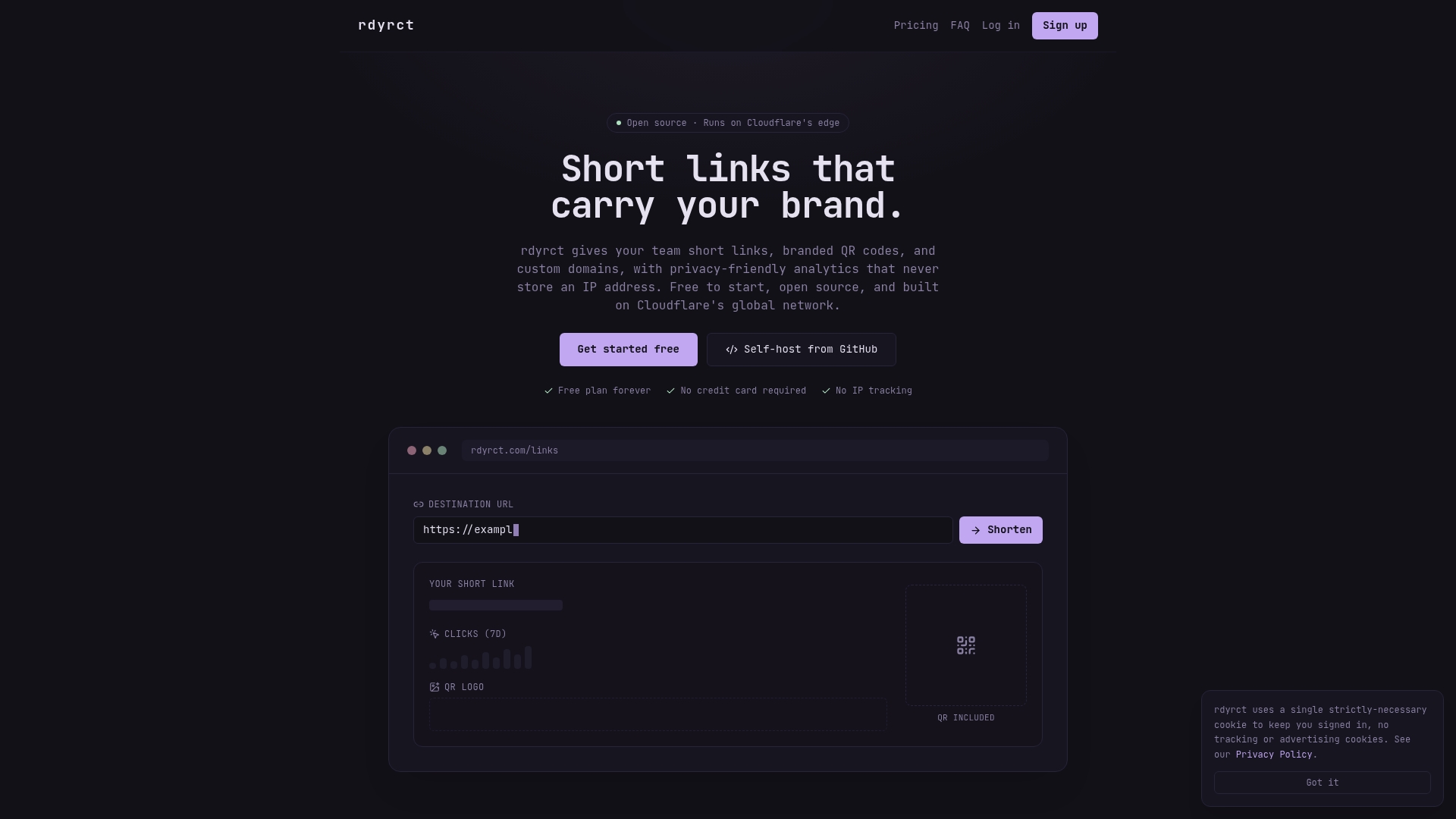
Beyond privacy, Rdyrct covers the full stack: branded short links, customizable QR codes, UTM parameter builder, custom domains, link health monitoring, live click feeds, and team roles, all under one platform. Developers get a documented API and a self-hosted Cloudflare option for teams with strict data-sovereignty requirements.
- Privacy-compliant analytics: referrer, device, and geo data with no IP address storage
- Branded QR codes + short links: custom domains and branded codes on paid plans
- API and team roles: built for collaborative campaigns and developer workflows
Start with Rdyrct’s free plan and see how far privacy-first analytics actually gets you before spending a dollar.
Further reading and sources
- Top Flowcode alternatives on G2 — community reviews and feature comparisons updated regularly
- Flowcode user reviews on G2 — real user sentiment on pricing, scan limits, and usability
- The role of QR codes in marketing — Forbes Business Council — covers dynamic vs. static strategy and campaign best practices
- How to create a QR code: complete guide — Pageloot — covers dynamic vs. static trade-offs and typical pricing ranges
- 6 best GDPR-compliant analytics tools in 2026 — Markletic — context on privacy-first analytics trends relevant to QR platform selection
- Flowcode alternatives on SaaSHub — aggregated community rankings and feature notes
Pricing and feature limits change. Confirm current plans directly on each vendor’s site before making a purchasing decision.