Live Click Tracking: Real-Time Insights for Marketers
Live Click Tracking: Real-Time Insights for Marketers
Live click tracking streams user clicks as they happen so teams can spot problems and run quick tests in real time, instead of waiting hours for a batch report to catch up. It captures the click target, the timestamp, and device or referrer data the moment a person taps or clicks, then pushes that event into a feed you can watch live.
Three things matter if you’re evaluating this for your own site or campaign. First, it captures the specific element clicked, when, and from what device or channel, not just a raw count. Second, the top use cases are campaign debugging during launches, monitoring new features right after release, and catching UX problems like a dead button before hundreds of visitors hit the same wall. Third, you can build this in a privacy-respecting way, and you should. That means skipping IP storage, minimizing personal fields, and giving people a clear opt-out where consent laws require one.
- What it captures: click target (element ID or link), exact timestamp, device type, referrer source.
- Where it earns its keep: campaign launch monitoring, landing page CRO tests, broken-link detection, QR code and short-link performance.
- Privacy baseline: collect without storing IP addresses, keep fields minimal, and set clear retention limits from day one.
Key Takeaways
Live click tracking works because it turns click events into an immediate, actionable feed instead of a delayed report, letting teams catch problems and validate changes within minutes rather than days.
| Point | Details |
|---|---|
| Use durable data attributes | Tag clickable elements with data-track-id instead of CSS selectors, which drift as designs change. |
| Pick transport by latency need | Use WebSocket or SSE for sub-second visibility; batched HTTP is fine for near-real-time needs. |
| Watch for noise sources | Filter bot spikes, mobile tap offsets, and duplicate events from retries before trusting a spike. |
| Keep privacy minimal by default | Skip IP storage, limit collected fields, and set a clear retention window from the start. |
| Start small this week | Add tracking IDs to your top five CTAs and watch a live feed on one campaign link before scaling further. |
| Consider a privacy-first option | Rdyrct pairs branded short links and QR codes with live click feeds and no IP storage, cutting the buildout time. |
Table of Contents
- What Is Live Click Tracking, Exactly?
- How Does Live Click Tracking Actually Work?
- Why Use Click Tracking in Real Time?
- What Limits the Accuracy of Live Click Data?
- How Do You Implement Live Click Tracking?
- How Do You Choose a Live Click Tracking Solution?
- How Do You Turn Live Click Data Into Action?
- How Rdyrct Supports Privacy-First Live Click Tracking
- Should You Build Your Own Live Click Feed or Buy One?
- Get Real-Time Click Visibility With Rdyrct
- Sources
What Is Live Click Tracking, Exactly?
The term covers a handful of related but distinct techniques, and mixing them up leads to the wrong tool for the job. Getting the vocabulary straight up front saves you from picking a heavyweight session-replay tool when a lightweight event tracker would do, or vice versa.
A click map (sometimes called a heatmap) aggregates thousands of clicks into a visual overlay on a page, showing where people click most. It’s great for spotting patterns at a glance but tells you nothing about an individual session or the sequence of events.
Event-based click tracking records each click as a discrete, timestamped event with metadata attached, such as the element ID, page URL, and device. This is the backbone of most modern analytics platforms and the foundation of anything you’d call “live.” Click tracking in this sense is the practice of recording where users click or tap across websites, apps, and emails, and it’s been a standard measurement technique for well over a decade.
Link or URL trackers, including short links, wrap a destination URL in a trackable redirect so you know who clicked, when, and from where, without needing to touch the destination page’s code at all.
Session replay records a full visual playback of a user’s mouse movements, scrolls, and clicks, reconstructed frame by frame. It’s the richest data type but also the heaviest, both in storage and in privacy exposure.
A few terms worth locking down before moving further:
- Rage clicks: repeated, rapid clicks on the same element, almost always a sign of frustration or a broken interaction.
- Dead clicks: clicks on something that looks interactive but does nothing, a classic UX red flag.
- Unique clicks: the count of distinct users or sessions who clicked, as opposed to total click volume, which can be inflated by one person clicking five times.
When this article says “live,” it means sub-second to a few seconds of latency between the click and its appearance in your feed or dashboard, not the 24-hour delay you’d get from a standard batch analytics export. And “click” here covers mouse clicks, touch taps on mobile, and programmatic activations like a screen reader triggering a button through keyboard navigation.
How Does Live Click Tracking Actually Work?
Under the hood, a live click tracking system has four jobs: capture the event, identify what was clicked, transport the data somewhere useful, and store it in a form you can query. Each stage has real trade-offs.
Capture typically happens through DOM event listeners attached to clickable elements, or through pointer sampling that watches broader interaction zones. Single-page applications complicate this because navigation doesn’t trigger a full page load, so you need listeners that survive route changes and can distinguish a real click from a programmatic or “pseudo” click fired by a script. Analytics libraries such as Snowplow handle this through configurable link click tracking that supports options like pseudoClicks and trackContent, capturing the destination URL and element metadata automatically.
Identity is where a lot of tracking setups quietly fall apart. Teams often target elements using CSS selectors, .hero-button or nav > ul > li:nth-child(3), which look convenient until a designer reorders the navigation and every selector silently breaks. The more durable pattern is to attach stable data attributes like data-track-id directly to the element, decoupling your tracking contract from your CSS. A declarative tracking-plan approach that defines sections, click zones, and pointer rules ahead of time reduces this kind of drift even further, letting teams derive higher-level signals instead of shipping raw pointer coordinates everywhere.
Transport is the real-time part of “real-time.” Traditional analytics batches events and sends them every few seconds or minutes via XHR or fetch with keepalive, which is fine for dashboards but too slow for live monitoring. WebSockets or Server-Sent Events (SSE) push data continuously with sub-second delay, which is what you want when you’re watching a campaign launch unfold. Webhook and postback patterns work well when you need to notify a downstream system, like a Slack channel or a CRM, the moment a specific event fires.
Here’s a typical data envelope for a click event and what each field is for:
| Field | Purpose |
|---|---|
| event_id | Unique identifier to deduplicate retried events |
| timestamp | When the click happened, to the millisecond |
| page_id / element_id | What was clicked, tied to a durable data attribute |
| element_type | Button, link, image, or custom component |
| href | Destination URL, if applicable |
| client_device | Mobile, desktop, tablet, and browser/OS details |
| referrer | Where the visitor came from |
| session_id | Groups clicks into a single visit without personal identifiers |
| privacy_flags | Consent status and anonymization markers |
For high-traffic pages, you’ll also need to think about batching strategy, backpressure (what happens when your server can’t keep up with the event volume), and whether to sample a percentage of events rather than capturing every single one. Open-source client libraries commonly expose these as configuration knobs, things like batchSize, batchInterval, and anonymizeIp, which let you tune the balance between completeness and system load.
- WebSocket/SSE: best for sub-second dashboards during launches. Needs backpressure handling at scale.
- Batched HTTP/fetch: simpler, cheaper, fine for near-real-time (seconds, not milliseconds) use cases.
- Webhooks: best for triggering downstream actions, not for visualizing volume.
Why Use Click Tracking in Real Time?
The honest case for live click tracking isn’t that it replaces your standard analytics. It’s that batch data answers “what happened yesterday” while live data answers “is this working right now.”
Consider a product launch. You push a new landing page live at 9 a.m. and start a paid campaign an hour later. With a live click feed, you can watch the first hundred clicks arrive within seconds, confirm the referrer breakdown matches your ad spend, and catch a broken redirect before you’ve burned through your daily budget. Without it, you might not notice the problem until the next morning’s report, by which point you’ve paid for clicks that went nowhere.
Or take a CRO test on a checkout page. You launch a new call-to-action button and watch the live feed. If you see a cluster of rage clicks on the button, tap after tap with no page change, that’s a strong, immediate signal something is broken, whether it’s a JavaScript error or a button that visually looks clickable but isn’t wired up. You can push a fix within the hour instead of discovering the problem in next week’s conversion report.
Beyond these two scenarios, live click tracking earns its place in several recurring situations:
- Campaign debugging: confirming clicks and referrers match expected traffic sources within the first hour of a launch.
- Feature monitoring: watching adoption of a newly shipped feature in real time rather than waiting for a weekly digest.
- Broken link detection: catching redirect loops or 404s on short links before they burn through campaign traffic.
- QR code and short-link performance: since QR codes route through a redirect, a live feed shows scan-to-click conversion the moment it happens, letting you compare QR scans versus link clicks on the same campaign.
Marketing ops teams use this to protect ad spend. Product teams use it to validate that a new feature is actually being touched. QA and DevOps teams use it as an early-warning system, since a sudden drop in click volume on a critical page can indicate a deployment problem faster than most uptime monitors will.
What Limits the Accuracy of Live Click Data?
No click tracking setup is perfectly clean, and pretending otherwise leads to bad decisions based on noisy data. A few sources of distortion show up again and again.
Bot traffic is the most common one. Automated crawlers, scrapers, and security scanners generate clicks that look real but aren’t, and they tend to spike unpredictably rather than following normal human traffic patterns. A sudden burst of identical clicks from the same referrer, arriving in a tight time window, is usually a red flag worth filtering.
Mobile tap offsets cause a different kind of noise. On touchscreens, the reported tap coordinates don’t always align precisely with the visual element a person meant to hit, especially on smaller buttons or dense navigation menus. This can make a perfectly functional button look like it’s generating dead clicks when the real issue is a few pixels of misalignment.
Single-page applications introduce their own trap: because navigation happens without a full page reload, naive tracking setups can lose events during route transitions or double-count a click that fires once on the visual interaction and again on a delayed state change. Cross-domain attribution gaps are another quiet problem. If a user clicks a link on your site that lands on a partner domain, standard referrer data often breaks at that boundary, leaving you with an incomplete picture of the full journey.
Duplicate events from network retries are worth watching too. If a client resends an event because it didn’t get an acknowledgment fast enough, and your backend doesn’t deduplicate by event_id, your click counts will run artificially high, sometimes by a meaningful margin depending on connection quality.
Pro Tip: Set up a simple sanity check comparing your live feed’s daily total against your standard analytics platform’s count for the same period. A gap of more than a few percentage points, in either direction, usually points to either duplicate events or a filtering gap worth investigating.
None of this means live tracking is unreliable, but it does mean you need a privacy and accuracy checklist before you ship it:
- Capture consent status before logging any personal data, and respect regional requirements for opt-in versus opt-out.
- Skip IP address storage entirely where possible, since it’s rarely needed for click analysis and adds real compliance risk.
- Keep the data schema minimal: click target, timestamp, device type, and referrer usually cover the analytical need without collecting anything identifying.
- Set a defined retention window and purge raw event logs once they’ve aged past their useful analytical life.
- Consider cookieless measurement approaches, which sidestep a whole category of consent friction while still delivering session-level insight.
How Do You Implement Live Click Tracking?
Getting a basic live click feed running doesn’t require a huge engineering lift, but skipping steps here is exactly how teams end up with unreliable data six months later. Work through this checklist in order.
- Define a tracking plan first. Decide what pages, sections, and elements matter before writing a single listener. A declarative plan keeps the whole team aligned on what’s being watched and avoids ad hoc tracking calls scattered across the codebase.
- Mark durable element IDs. Add
data-track-idattributes to every element you plan to track, rather than relying on CSS classes or DOM position, which shift every time someone touches the front end. - Instrument capture listeners. Attach click and tap listeners tied to those data attributes, and make sure they survive single-page app route changes.
- Choose your transport. WebSocket or SSE for sub-second visibility during launches; batched HTTP for near-real-time needs where a few seconds of delay is acceptable.
- Define your event schema. Lock in field names (event_id, timestamp, element_id, and so on) before you start sending production traffic, so downstream systems don’t need reworking later.
- Set sampling and backpressure rules. For high-traffic pages, decide whether you’ll capture every event or a representative sample, and how your backend handles load spikes.
- Add privacy filters at the source. Strip IP addresses and unnecessary personal fields before the event ever leaves the browser, not after it lands in storage.
- Test in staging with real interaction patterns. Click through the actual user flows yourself, not just a synthetic test click, to confirm the schema captures what you expect.
A minimal client-side pattern looks something like this:
document.addEventListener('click', function(event) {
  const target = event.target.closest('[data-track-id]');
  if (!target) return;

  const payload = {
    event_id: crypto.randomUUID(),
    track_id: target.dataset.trackId,
    timestamp: Date.now(),
    href: target.href || null,
    page_id: window.location.pathname
  };

  socket.send(JSON.stringify(payload));
});
That’s deliberately bare bones. In production you’d add retry logic, batching for high-frequency pages, and consent checks before the listener even fires.
A basic event schema for reference:
Pro Tip: Roll out data attributes incrementally, starting with your top five highest-traffic CTAs, rather than trying to tag every clickable element on the site at once. CSS selectors drift constantly as designs change, and a small, well-maintained set of durable tracking IDs beats a large, brittle one that breaks every sprint.
How Do You Choose a Live Click Tracking Solution?
Whether you’re comparing vendors or weighing a build against a buy decision, the same handful of questions separate a solution that’ll hold up under real traffic from one that looks fine in a demo.
Start with latency guarantees. Ask specifically what “real-time” means in their documentation, sub-second, a few seconds, or “usually fast.” Vague answers here tend to translate into disappointing production behavior. Next, check event schema flexibility: can you add custom fields without waiting on a vendor’s roadmap, or are you locked into a fixed set of attributes? Then look at integrations, specifically whether the platform supports webhooks, direct connections to your analytics stack, and export to a data warehouse for long-term analysis. Teams routing high-volume click data into broader reporting systems often lean on established analytics and reporting frameworks to keep that pipeline manageable at scale.
Pricing models for high-volume feeds deserve close scrutiny too, since a per-event cost that looks negligible at 10,000 clicks a month can become painful at 10 million. And privacy defaults matter more than most vendors advertise: ask directly whether IP addresses are stored by default, and what the process looks like to disable that.
Specific questions worth asking a vendor or your own engineering team before committing:
- What’s the actual delivery SLA for events reaching the dashboard or webhook?
- Is there a default sample rate at high volume, and can it be adjusted?
- How does the system behave on retry, does it risk duplicate events?
- What access controls exist for team members viewing live data?
- What’s the data retention window, and is it configurable?
Different priorities apply depending on whether you’re optimizing for a single launch or long-term product analytics:
| Evaluation category | Matters most for launches | Matters most for long-term analytics |
|---|---|---|
| Latency | Critical, sub-second visibility needed | Helpful, but seconds-level delay is fine |
| Schema flexibility | Less critical short term | Critical for evolving product needs |
| Retention length | Short window acceptable | Long-term storage and export matter |
| Pricing model | Burst-friendly pricing helps | Predictable volume pricing matters more |
How Do You Turn Live Click Data Into Action?
Watching a live feed is only useful if you know which signals deserve attention and which are just noise. A handful of metrics carry most of the weight.
Click volume tells you whether traffic is flowing as expected. Unique clicks tell you how many distinct people are actually engaging, which matters more than raw volume when you’re gauging real interest. Rage clicks flag frustration in near real time. Dead clicks flag broken or misleading interface elements. And watching where clicks drop off along a conversion path, say, from product page to cart to checkout, shows you exactly where people give up.
Once you’ve spotted a signal, prioritize it using a simple impact times frequency framework:
- Estimate impact. How much revenue, conversion, or user trust is at stake if this issue persists?
- Estimate frequency. Is this happening to 2% of visitors or 40%?
- Multiply the two. A high-impact, low-frequency issue (a broken checkout for users on one obscure browser) might rank below a moderate-impact, high-frequency issue (a confusing CTA every visitor sees).
- Assign the top-ranked issue an owner and a deadline, not just a note in a backlog.
A simple hypothesis template keeps this disciplined: “We believe [specific change] will [specific outcome] because [live signal observed]. We’ll know we’re right if [measurable result] within [timeframe].”
Two quick examples of this in practice: a team notices a cluster of dead clicks on a pricing page tooltip icon that looks clickable but isn’t wired to anything. The fix, wiring up the tooltip, ships within a day, and dead clicks on that element drop to near zero the following week. In another case, a live feed shows a spike in referrer traffic from a specific short link during a product launch, but the destination page’s click-through rate on the primary CTA is unusually flat. The team discovers the CTA button is rendering below the fold on smaller screens and adjusts the layout the same afternoon, rather than waiting for the weekly report to flag the drop.
How Rdyrct Supports Privacy-First Live Click Tracking
A live click tracking setup is only as good as the data pipeline behind it, and that’s the part most teams underestimate when they’re focused on dashboards and heatmaps. Rdyrct approaches this from the link side: every branded short link and QR code it generates comes with a live click feed attached, showing referrer, device, and country data as clicks happen, without ever storing the visitor’s IP address.
That matters most in exactly the scenarios covered above. A campaign launch running through a short link gets the same first-hour visibility a custom event pipeline would give you, minus the engineering lift of building one from scratch. A QR code on a physical flyer or product package routes through the same live feed, letting you compare scan-driven traffic against digital-only sources in the same view.
- Live click feeds on every short link and branded QR code, showing device and referrer metadata as events arrive.
- Webhook and API access for streaming click events directly into your existing analytics stack or data warehouse.
- Privacy-preserving defaults, including no IP storage, which supports the kind of cookieless measurement approach that keeps consent friction low while still giving you session-level insight.
For teams already running server-side logging or serverless infrastructure, the API-based approach pairs naturally with Cloudflare Workers-based logging patterns, letting event data flow into the same pipeline you’re already maintaining for other services.
Pro Tip: If you’re testing a new campaign or landing page for the first time, start with a single branded short link rather than instrumenting your entire site. You’ll see live click behavior on that one link within seconds of the first click, without touching a line of your site’s existing code.
Should You Build Your Own Live Click Feed or Buy One?
The honest answer to “build or buy” depends less on budget and more on what you’re actually optimizing for, and most teams get this backwards. They start by comparing sticker prices instead of asking what a delay in getting reliable data actually costs them.
Building your own pipeline makes sense when you have a genuinely unusual integration need, tracking clicks inside a proprietary internal tool, say, where no off-the-shelf product will ever fit, or when you have engineering capacity sitting idle and a long time horizon to justify the maintenance burden. What people underestimate is that the hard part isn’t the initial build. It’s the ongoing maintenance: keeping schemas consistent as your product evolves, handling the privacy compliance questions that inevitably come up in a legal review, and dealing with the backpressure and retry logic that only reveals itself once you’re at real production volume. A weekend prototype and a production-grade event pipeline are two very different projects wearing the same name.
Buying makes more sense in almost every other case, and not because building is impossible, but because the time-to-value gap is enormous. A privacy-first service with sane defaults already baked in saves you the compliance research, the schema design debates, and the months of hardening a homegrown system needs before it’s trustworthy at scale.
- Choose build when you need a highly specific internal integration, have committed engineering time, and expect the tracking need to stay stable for years rather than months.
- Choose buy when speed matters, when you want privacy compliance handled by default rather than negotiated in a legal review, and when ongoing maintenance isn’t a job you want on anyone’s plate.
Get Real-Time Click Visibility With Rdyrct
Skip the months of engineering work that a homegrown live click pipeline demands. Rdyrct gives you branded short links and QR codes with a live click feed built in from the start, showing referrer, device, and country data the moment someone clicks, without ever storing an IP address.
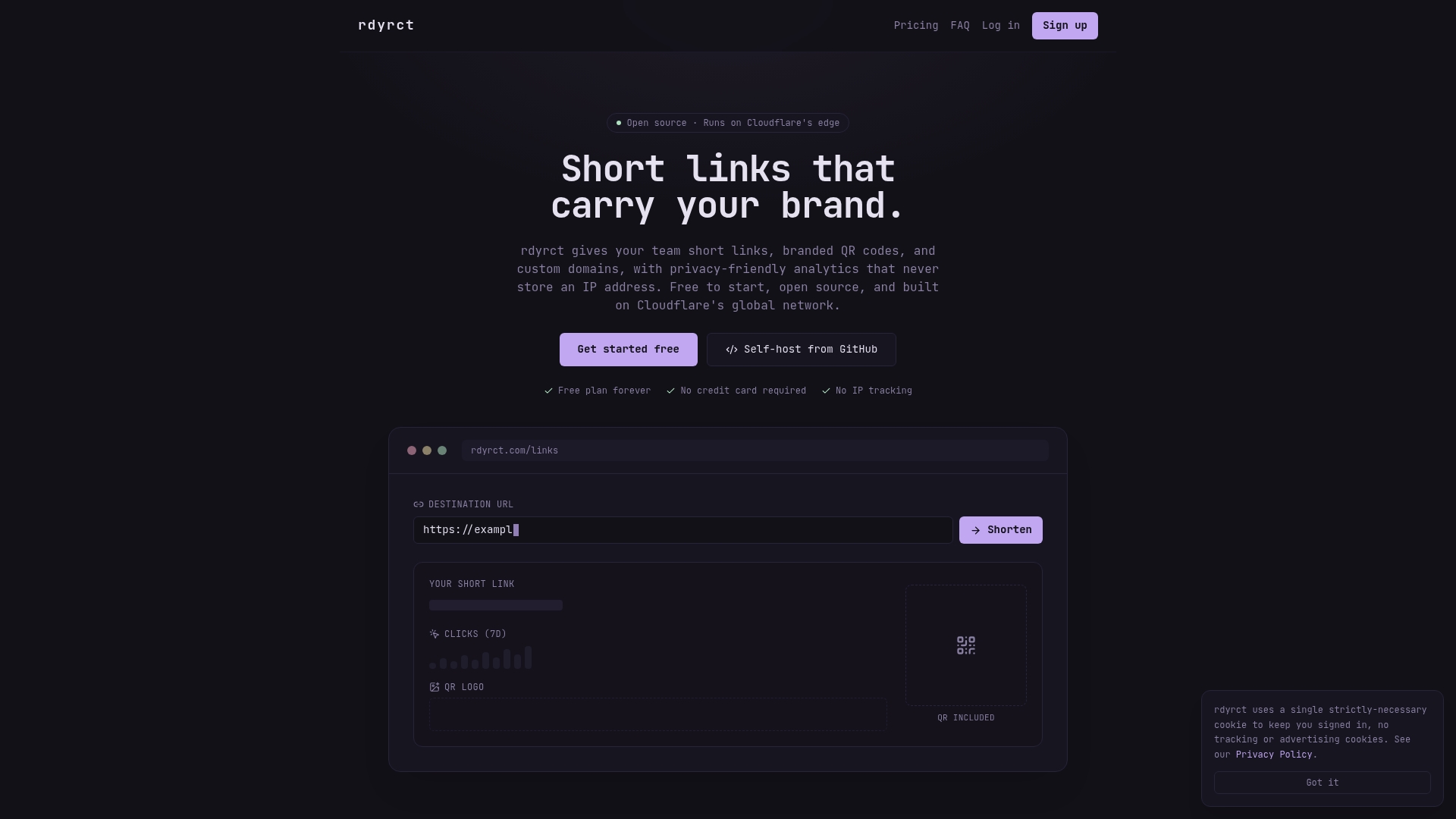
For marketers running a launch, that means watching campaign traffic arrive in real time instead of waiting on tomorrow’s report. For developers, it means an API and webhook layer ready to stream events into whatever analytics stack you already run.
- Live click feeds on every short link, showing device and referrer breakdowns as events happen.
- Branded QR codes that route through the same real-time tracking as your short links.
- Webhook and API integrations for pushing click data straight into your existing tools.
Rdyrct offers a free forever plan, so you can start seeing live click data on your first campaign without committing to anything. Create your first branded link and watch the clicks come in.