Is an IP Address Personal Data? What Privacy Teams Need to Know
Is an IP Address Personal Data? What Privacy Teams Need to Know
Under GDPR, an IP address can be personal data. Under U.S. law, it often qualifies as personal information too. The deciding factor in both frameworks is not what the IP looks like in isolation but whether it can be linked, directly or indirectly, to an identified or identifiable individual or household.
- GDPR verdict: GDPR Art. 4(1) and Recital 30 explicitly list IP addresses among online identifiers that can constitute personal data. The test is identifiability, not certainty of identification.
- U.S. verdict: Under CCPA-style statutes and FTC guidance, an IP address is personal information when it is reasonably linkable to a consumer or household. Context determines the outcome.
- Breyer callout: In Breyer (C‑582/14), the Court of Justice of the EU held that a dynamic IP address can be personal data for a website operator if that operator has the legal means to identify the person by combining the IP with data held by the ISP.
“A dynamic IP address registered by an online media services provider when a person accesses its website constitutes personal data within the meaning of [the Directive] in relation to that provider, where the latter has the legal means which enable it to identify the data subject with the assistance of additional information which the internet service provider has about that person.” — CJEU, Breyer v. Germany, C‑582/14
For the legal definitions and their source texts, go to the next section. For a U.S.-focused compliance checklist, jump to Section 8.
Key Takeaways
An IP address is personal data under GDPR when identifiability is reasonably possible, and personal information under CCPA when it is reasonably capable of being associated with a consumer or household.
| Point | Details |
|---|---|
| GDPR identifiability test | An IP is personal data if the controller has legal or technical means to link it to a natural person, even via a third party like an ISP. |
| CCPA “reasonably capable” standard | California law covers IPs that can reasonably be associated with a consumer or household, making context and auxiliary data decisive. |
| Anonymization bar is high | Truncating the last octet or hashing an IP is pseudonymization, not anonymization; GDPR obligations still apply to pseudonymized IPs. |
| Document your assessment | Regulators and auditors expect a written identifiability assessment, not just technical controls; the reasoning record is as important as the outcome. |
| Rdyrct eliminates the IP layer | Rdyrct’s link analytics platform delivers referrer, device, and country data without storing raw IPs, removing IP-specific obligations from the analytics stack. |
Table of Contents
- What “personal data” and “personal information” mean under GDPR and CCPA
- How IP address types affect identifiability
- How GDPR and EU case law treat IP addresses
- How U.S. law treats IP addresses: CCPA, FTC, and the practical differences
- When does an IP address actually become personal data in practice?
- Anonymization vs. pseudonymization: when an IP stops being personal data
- Compliance checklist for U.S. organizations that collect or log IP addresses
- Privacy-preserving analytics: how to collect useful data without storing IPs
- The part of this debate that most compliance guides miss
- Rdyrct gives you link analytics without the IP compliance burden
- Primary sources and further reading
- Sources
What “personal data” and “personal information” mean under GDPR and CCPA
The two frameworks use different terms but share a core logic: if data can be tied to a real person, it is regulated.
GDPR: Art. 4(1) and Recital 30
GDPR Art. 4(1) defines personal data as “any information relating to an identified or identifiable natural person.” A person is identifiable when they can be identified “directly or indirectly, in particular by reference to an identifier such as a name, an identification number, location data, an online identifier.” Recital 30 goes further, naming IP addresses, cookie identifiers, and radio frequency tags as examples of online identifiers that “may leave traces which, in particular when combined with unique identifiers and other information received by the servers, may be used to create profiles of the natural persons and identify them.”
CCPA/CPRA: the “reasonably capable” standard
California’s Consumer Privacy Act defines personal information as information that “identifies, relates to, describes, is reasonably capable of being associated with, or could reasonably be linked, directly or indirectly, with a particular consumer or household.” The phrase “reasonably capable” is the operative one. It sets a lower bar than certainty and a higher bar than theoretical possibility. IP addresses appear in the CCPA’s non-exhaustive list of identifiers.
Side-by-side: GDPR vs. CCPA on IP addresses
| Dimension | GDPR | CCPA/CPRA |
|---|---|---|
| Covered entity | Any controller processing EU residents’ data | Qualifying businesses handling California consumers’ data |
| Legal test | Identifiable natural person (direct or indirect) | Reasonably capable of being associated with a consumer or household |
| IP addresses named? | Yes — Recital 30 | Yes — listed as an identifier |
| Key rights triggered | Access, erasure, portability, restriction | Know, delete, opt-out of sale/sharing, correct |
| Retention obligation | No longer than necessary for the stated purpose | No explicit statutory limit; FTC and AG guidance apply |
| Enforcement | National DPAs; fines up to 4% of global turnover | California AG; private right of action for data breaches |
The ICO’s guidance on personal information reinforces this framing: controllers must consider whether identification is reasonably likely given all means available, not just the data they hold today.
How IP address types affect identifiability
Not all IP addresses carry the same privacy weight. The technical variety matters because it changes how easily an IP can be traced back to a person.

Static vs. dynamic IPs
A static IP is permanently assigned to a subscriber. ISPs maintain a consistent record linking that address to an account holder, which makes re-identification straightforward for anyone with access to those records. A dynamic IP changes each time a device reconnects. It is still linkable to a subscriber, but only for the window when that IP was assigned, and only if the ISP’s logs are preserved and accessible. The Breyer court addressed dynamic IPs specifically because they seemed harder to link, yet still found them potentially personal data.
Public vs. private IPs and NAT
The IP a website sees is the public IP assigned at the network boundary, typically a router or gateway. Devices behind that router use private IP ranges (192.168.x.x, 10.x.x.x) that are invisible to external servers. Network Address Translation (NAT) maps many private addresses to one public IP, so a single logged IP might represent dozens of users sharing a home router, a corporate network, or a mobile carrier pool. Carrier-grade NAT, used by mobile operators, can aggregate thousands of subscribers behind one address, which substantially reduces immediate identifiability.
Shared and proxy IPs
- Public Wi-Fi hotspots assign one IP to every connected device, making individual attribution nearly impossible without additional data.
- Corporate networks route all employee traffic through a single gateway IP.
- VPNs replace the user’s real IP with the VPN provider’s address, shifting the identifiability question to the VPN’s own logs.
- Proxy servers introduce a similar layer of indirection.
What a website actually sees
When a browser loads a page, the server records the source IP of the TCP connection. That IP belongs to the last network hop before the server, usually the user’s ISP gateway or a proxy. The server does not see the device’s internal address. The ISP, however, holds the subscriber record that maps the public IP to an account at a given timestamp. That is the “additional data” the Breyer court had in mind.
As Norton’s consumer guidance notes, an IP address alone rarely reveals a person’s identity, but combined with timestamps, browsing patterns, or account data, it can assist profiling and re-identification.
How GDPR and EU case law treat IP addresses
The EU’s position is the most developed globally, anchored by a binding CJEU judgment and consistent supervisory authority guidance.
The Breyer ruling (C‑582/14)
Patrick Breyer, a German politician, sued the German federal government for logging his dynamic IP address when he visited a government website. The legal question: does a dynamic IP constitute personal data for the website operator, even though the operator itself cannot identify the user without going to the ISP?
The CJEU said yes, under a relative identifiability test. The court reasoned that if the operator has a legal means to obtain the linking data from the ISP (for example, through a law-enforcement channel or a court order), then identification is not merely hypothetical. The operator need not hold the ISP data itself; it is enough that the means to obtain it exist and are accessible.
“It is not required that all the information enabling the identification of the data subject must be in the hands of one person.” — CJEU, Breyer, C‑582/14
Supervisory authority alignment
The European Commission’s guidance confirms that IP addresses are among the online identifiers that can make a person identifiable. The Dutch Data Protection Authority takes the same position, explaining that data not directly about someone can still be personal data if it is traceable to that person, and it lists IP addresses as a clear example.
Practical implications for EU controllers:
- A website operator that logs IPs and can, in principle, obtain subscriber data from an ISP via legal process is almost certainly processing personal data.
- A third-party analytics provider that receives only raw IPs with no subscriber-linking capability may occupy a different position, but the controller who shares those IPs still bears responsibility.
- The Breyer reasoning applies to dynamic IPs; static IPs are easier to link and therefore more clearly personal data.
- Controllers must document their identifiability assessment and apply appropriate safeguards regardless of whether they ever actually attempt identification.
How U.S. law treats IP addresses: CCPA, FTC, and the practical differences
The U.S. does not have a single federal privacy law equivalent to GDPR. Instead, a patchwork of state statutes and FTC enforcement shapes how IP addresses are treated.
CCPA/CPRA statutory test
California Civil Code § 1798.140 defines personal information to include “unique identifiers” and “internet protocol addresses.” The statute’s “reasonably capable of being associated with” standard means that an IP address collected alongside a timestamp, a device fingerprint, or an authenticated session is almost certainly personal information under California law. An IP collected in bulk, aggregated immediately, and stripped of all linking context sits in a grayer zone.
FTC enforcement posture
The FTC does not enforce CCPA, but its Bureau of Consumer Protection treats deceptive or unfair data practices as violations of Section 5 of the FTC Act. In the children’s context, COPPA explicitly covers persistent identifiers, including IP addresses, as personal information when collected from children under 13. This signals the FTC’s broader view that persistent online identifiers carry privacy significance.
Key practical differences from GDPR:
- Scope: CCPA covers consumers and households; GDPR covers natural persons. CCPA’s household scope can make a shared IP more clearly covered.
- Rights and remedies: CCPA grants rights to know, delete, correct, and opt out of sale or sharing. GDPR adds portability and restriction. CCPA’s private right of action is limited to data breaches; GDPR allows broader individual claims.
- Thresholds: CCPA applies only to qualifying businesses (revenue, data volume, or revenue-from-data thresholds). GDPR applies to any controller processing EU residents’ data, regardless of size.
- Cross-border: A U.S. company serving EU users must comply with GDPR for those users even if it is headquartered in California and already CCPA-compliant.
- Enforcement: CCPA enforcement sits with the California AG and the California Privacy Protection Agency. FTC enforcement is federal but relies on Section 5 and sector-specific rules rather than a comprehensive privacy statute.
When does an IP address actually become personal data in practice?
Identifiability is not a fixed property of an IP address. It is a function of context, data holdings, and the means available to the controller. Privacy International’s analysis makes this explicit: the same IP may be personal data for one organization and not for another.
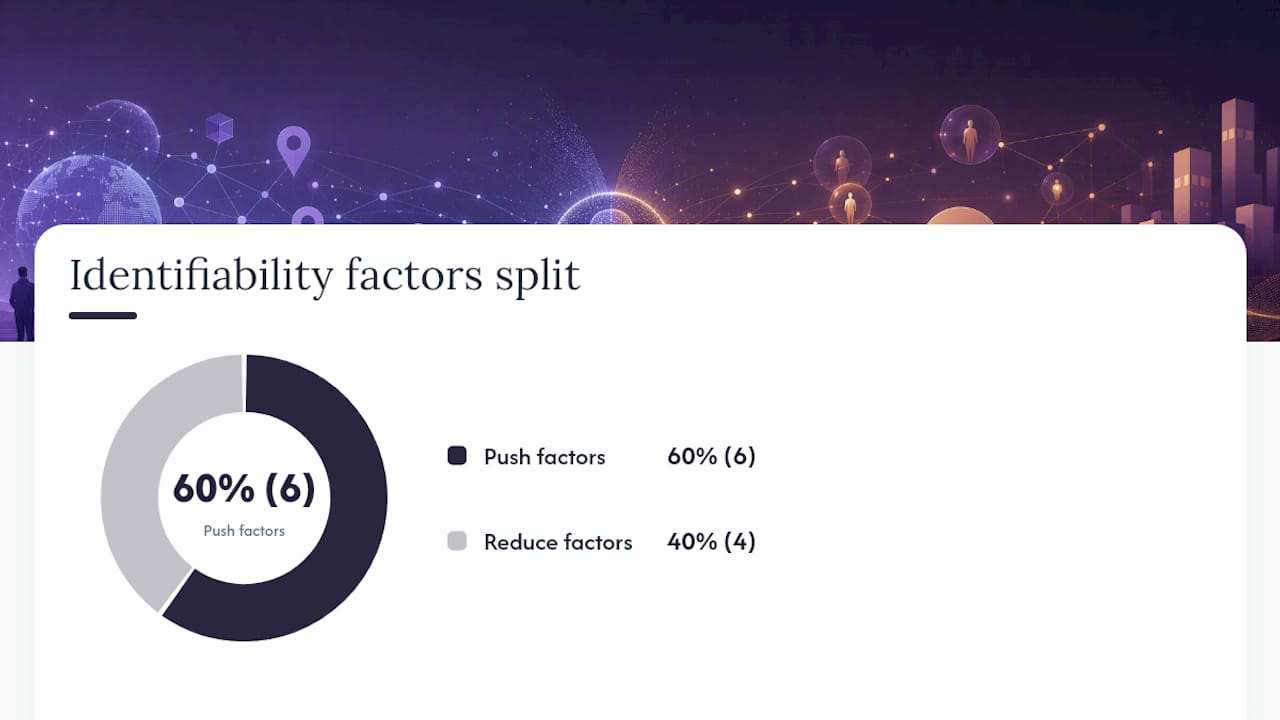
Factors that push an IP toward personal data status:
- Timestamps that narrow the window of possible users
- Combination with cookies, device fingerprints, or browser characteristics
- Account authentication logs that tie the IP to a named user
- Small sample size (a single-user network or a small office)
- Access to ISP subscriber records or law-enforcement channels
- Third-party data enrichment services that resolve IPs to individuals
Factors that reduce identifiability:
- Carrier-grade NAT with thousands of subscribers behind one IP
- Immediate aggregation with no per-IP retention
- Truncation of the last octet before storage (e.g., 203.0.113.x)
- No auxiliary datasets linking the IP to any other identifier
Real-world examples:
- An e-commerce site logs the IP of an authenticated checkout session alongside the account email. That IP is personal data.
- A law-enforcement agency issues a subpoena to an ISP for subscriber records matching a specific IP and timestamp. The IP was personal data from the moment it was logged.
- A news site collects raw IPs for server load analysis, aggregates them into hourly request counts, and discards the raw logs within 24 hours. The aggregated counts are not personal data; the raw logs were, briefly.
Decision flow for your team:
- Identify every system that logs or processes IP addresses.
- For each system, ask: does the organization hold, or can it legally obtain, data that links this IP to a specific person or household?
- If yes, treat the IP as personal data and apply full compliance obligations.
- If no, document the reasoning and the technical controls that prevent linkage.
- Reassess whenever data holdings change, new vendors are added, or the processing purpose shifts.
Pro Tip: Document step 4 in writing. Regulators and auditors want to see the reasoning, not just the technical outcome. A one-page identifiability assessment stored with your data inventory is far more defensible than an undocumented assumption.
Anonymization vs. pseudonymization: when an IP stops being personal data
The distinction matters because pseudonymized data is still personal data under GDPR; truly anonymized data is not.
Pseudonymization replaces a direct identifier with a substitute (a hash, a token) but leaves the data re-linkable if the key or the original dataset is available. Hashing an IP address with a secret salt is pseudonymization. The hashed value is still personal data because the original IP can be recovered by anyone with the salt, and the hash itself may be consistent enough to enable tracking across sessions.
Anonymization requires that re-identification be “reasonably impossible” given all means likely to be used. The ICO and GDPR guidance set a high bar: if there is any realistic path back to the individual using available auxiliary data, the data is not truly anonymous.
NIST SP 800-122 recommends a risk-based approach: assess the confidentiality impact of each identifier, consider linkage risk with auxiliary datasets, and apply controls proportionate to that risk. NIST treats IP addresses as PII when they are linkable to a specific device or small group.
Common pitfalls that leave re-identification risk:
- Storing hashed IPs with a static, organization-wide salt (the hash is consistent across sessions and linkable)
- Truncating only the last octet while retaining timestamps and user-agent strings (combination still identifies small networks)
- Retaining raw IPs in backup systems after deleting them from production
- Using third-party analytics that receive full IPs before any masking occurs
Do and don’t checklist:
- Do truncate the last octet before writing to any persistent store.
- Do aggregate metrics at the session or hourly level rather than per-IP.
- Do apply IP masking at the collection layer, before data reaches any database.
- Don’t rely on hashing alone as anonymization without assessing re-identification risk.
- Don’t assume that deleting IPs from your primary database removes them from logs, backups, or third-party processors.
- Don’t treat pseudonymization as a compliance endpoint; it reduces risk but does not remove GDPR obligations.
For a broader look at privacy-preserving analytics techniques, including masking and pseudonymization in practice, see Rdyrct’s guide on cookieless analytics.
Compliance checklist for U.S. organizations that collect or log IP addresses
This checklist is ordered by priority. Small teams should complete steps 1 through 4 before anything else.
-
Audit every IP logging point. List all systems (web servers, CDNs, load balancers, analytics platforms, APIs, email servers) that record IP addresses. Include third-party vendors.
-
Apply data minimization. Log only what you need. If the use case is fraud detection, you may need the full IP for a short window. If the use case is traffic analytics, a truncated or aggregated value is usually sufficient.
-
Set and enforce retention limits. Define a maximum retention period for raw IP logs (30, 60, or 90 days is common for operational purposes) and automate deletion. Document the rationale for the period chosen.
-
Update your privacy notice. Describe what IP data you collect, why, how long you keep it, and whether you share it with third parties. CCPA requires this disclosure for each category of personal information.
-
Implement hashing or truncation at the collection layer. If you do not need the full IP for a specific purpose, mask it before it reaches any persistent store. This reduces your compliance surface without eliminating analytical utility.
-
Document your identifiability assessment. For each processing activity involving IPs, record whether you treat the IP as personal information, why, and what controls apply. FTC enforcement actions consistently reward organizations that can show a documented, reasoned approach.
-
Handle data subject requests for IP-linked records. Under CCPA, consumers can request to know what personal information you hold about them and ask for deletion. If your logs tie an IP to an authenticated account, that record is in scope. Build a process to search and respond within the 45-day statutory window.
-
Review vendor contracts. Ensure data processing agreements with analytics vendors, CDN providers, and log management tools address IP data, retention limits, and sub-processor obligations.
-
Prepare a sample privacy-notice snippet you can adapt:
-
Assign ownership. Designate a person or team responsible for IP data governance. For organizations subject to CCPA, this person should also own the DSAR (data subject access request) process.
Privacy-preserving analytics: how to collect useful data without storing IPs
The practical alternative to storing raw IPs is to extract the useful signal at collection time and discard the identifier. This is not a theoretical exercise; it is how well-designed analytics pipelines work today.
A privacy-first link analytics workflow:
- At the moment a click arrives, perform a geo-lookup to resolve the IP to a country or region. Store the country code. Discard the IP.
- Record the referrer header, device type, and browser family. These are useful for campaign attribution and do not require the IP.
- Generate a short-lived, session-scoped identifier (a random token with a TTL of 24 hours or less) if you need to deduplicate clicks within a session. Never persist this token beyond its TTL.
- Aggregate all metrics at the event level, not the user level. Total clicks by country, by referrer, by device type — none of these require a stored IP.
Benefits and trade-offs:
- You eliminate the IP from your compliance surface entirely, which removes the need for IP-specific retention policies, DSAR searches across IP logs, and identifiability assessments for that data point.
- You lose the ability to do IP-based fraud detection on historical data. If fraud detection is a genuine requirement, consider storing a hashed IP with a rotating salt for a short window (24–72 hours), then deleting it.
- Aggregated, IP-free analytics satisfy both GDPR and CCPA practical obligations when the collection is documented and the privacy notice reflects what is actually collected.
Rdyrct is built on exactly this model. The platform provides referrer, device, and country-level analytics for every short link without storing raw IP addresses. That design choice means organizations using Rdyrct for link tracking do not inherit an IP logging problem. The analytics are useful; the compliance surface is smaller.
Pro Tip: When evaluating any analytics vendor, ask one specific question: “At what point in your pipeline is the IP address discarded, and can you show me that in your data flow documentation?” A vendor that cannot answer this precisely is storing the IP somewhere.
The part of this debate that most compliance guides miss
Most articles on IP addresses and personal data spend their energy on the legal definitions and then stop. The harder question is organizational: who in your company is actually making the identifiability call, and are they making it with the right information?
The Breyer test is relative. The same IP address is personal data for a company with ISP-linking capability and not personal data for a company with no such access. That means the answer changes as your data holdings change. A startup that today has no subscriber database might acquire one next year. An analytics vendor you trusted last year might have added a data enrichment feature that changes the identifiability calculus entirely.
Treating IP addresses as contextual identifiers rather than fixed-category data is the right mental model. It means the assessment is a living document, not a one-time checkbox. And when the facts are genuinely ambiguous, that is precisely when to involve legal counsel or a data protection officer rather than letting an engineer make the call alone. The cost of a wrong assumption is not just a regulatory fine; it is the loss of the trust that privacy-conscious users extend to organizations that handle their data carefully.
Rdyrct gives you link analytics without the IP compliance burden
Most link analytics tools log raw IP addresses by default. That means every click on every short link adds to your IP data inventory, your retention obligations, and your DSAR surface under CCPA.

Rdyrct takes a different approach. The platform delivers referrer, device, and country-level analytics for every branded short link without storing IP addresses at all. You get the campaign data you need: where clicks come from, what devices your audience uses, which referrers drive traffic. You do not get an IP log that requires a retention policy, an identifiability assessment, or a deletion workflow.
What that means in practice:
- No raw IP logs to include in DSAR responses
- No IP-specific retention limits to configure or audit
- Aggregated country and device metrics available in real time
- Branded QR codes and custom domains with the same privacy-first data model
Organizations with genuine compliance requirements should still review their full data stack. Rdyrct handles the link analytics layer. Rdyrct and see how much of your IP compliance surface disappears when the tool is designed not to create it.
Primary sources and further reading
The claims in this article draw on the following authoritative sources. Read the originals before making compliance decisions.
- GDPR Art. 4(1) and Recital 30 — European Commission guidance: primary text on the definition of personal data and the role of online identifiers.
- CJEU Breyer judgment, C‑582/14 (October 19, 2016): the binding EU ruling on dynamic IPs and the relative identifiability test.
- EUR-Lex full text of Breyer (62014CJ0582): full judgment text with paragraph-level reasoning.
- ICO — What is personal information?: UK supervisory authority guidance on online identifiers and the identifiability test.
- Dutch Data Protection Authority — What are personal data?: supervisory authority explanation of direct vs. indirect personal data, with IP address examples.
- NIST SP 800-122 — Guide to Protecting the Confidentiality of PII: U.S. federal guidance on PII classification, risk assessment, and safeguards.
- FTC — COPPA Rule: FTC rule covering persistent identifiers as personal information in the children’s context.
- FTC — Bureau of Consumer Protection: overview of FTC enforcement authority and privacy priorities.
- Privacy International — Are IP addresses personal data?: practitioner explainer on situational identifiability and auxiliary data.
- Norton — What can someone do with your IP address?: consumer-facing explanation of what an IP reveals and its limits.
This article is general information, not a substitute for advice from a qualified lawyer. Consult a qualified legal professional about your own circumstances before acting on anything here.
Sources
- Application of the GDPR - European Commission
- What is personal information: a guide | ICO
- NIST Special Publication 800-122 (Guide to Protecting the Confidentiality of PII)
- Children’s Online Privacy Protection Rule (COPPA) | FTC