Branded Short Links for Marketers and Developers
Branded Short Links for Marketers and Developers
For marketers and developers who need privacy-first branded short links, Rdyrct is the recommended pick. It combines custom domains, analytics that skip IP storage, and a flexible API, all on a free-forever plan that scales. If you need a quick shortlist before diving deeper:
- Privacy-first platform (recommended): Rdyrct — custom domains, no-IP analytics, QR codes, API, and self-hosting
- Marketing-heavy SaaS: Feature-rich platforms with deep UTM and retargeting support, but broader data collection
- Enterprise feature set: Team governance, SAML SSO, and audit logs at a premium price point
- Free-tier starter: Basic shortening with a shared domain, fine for testing but not for brand campaigns
Two things separate good picks from bad ones: whether you own the custom domain (DNS CNAME pointed at the provider) and whether the analytics respect your users’ privacy. Both matter before you sign anything.
| Category | Best For | Custom Domain | Analytics Depth | Privacy | Free Tier |
|---|---|---|---|---|---|
| Privacy-first platform | Marketers, developers, regulated industries | Yes | Referrer, device, geo | No IP storage | Yes |
| Marketing SaaS | Growth teams, agencies | Yes | Full funnel + retargeting | IP logged | Limited |
| Enterprise platform | Large orgs, IT-governed teams | Yes | Advanced + BI export | Configurable | No |
| Free-tier starter | Personal use, quick tests | Shared domain only | Basic click count | IP logged | Yes |
Table of Contents
- Which branded short-link providers should you actually consider?
- How do you choose the right branded short-link provider?
- How do you set up a branded short link from scratch?
- Why privacy-first short links matter for your campaigns
- How does domain management and renewal work?
- What should you expect from provider support?
- How reliable are branded short-link providers?
- How well do short-link platforms integrate with your marketing stack?
- Key Takeaways
- The privacy trade-off most marketers ignore
- Rdyrct gives you branded links without the privacy trade-off
- Useful sources and further reading
Which branded short-link providers should you actually consider?
These categories were chosen based on feature completeness, privacy posture, integration depth, and pricing transparency.
| Provider | Best For | Free Tier | Paid Starts At | Custom Domain | Analytics | Privacy | API | QR Codes | Team Features |
|---|---|---|---|---|---|---|---|---|---|
| Rdyrct | Privacy-first marketers & devs | Yes (unlimited links) | Hobby/Pro tiers | Yes | Referrer, device, geo | No IP storage | Yes | Branded QR | Roles, orgs |
| Rebrandly | Marketing teams, agencies | 10 links, 1 domain | ~$13/mo | Yes | UTM, clicks, geo | Standard | Yes | Yes | Team workspaces |
| Bitly | General marketing, social | 10 links/mo | ~$8/mo | Paid only | Clicks, referrer, geo | IP logged | Paid | Paid | Paid |
| TinyURL | Quick personal shortening | Unlimited (shared) | ~$9.99/mo | Paid | Basic | IP logged | Paid | No | Limited |
| Short.io | Developers, multi-domain | 1,000 links, 1 domain | ~$19/mo | Yes | Clicks, referrer, device | IP logged | Yes | Yes | Team roles |
| Replug | Content marketers, retargeting | 14-day trial | ~$19/mo | Yes | Full funnel, retargeting | IP logged | Yes | Yes | Team |
Pricing and tier limits sourced from Zapier’s 2026 URL shortener roundup.
Rdyrct
Rdyrct is the only provider in this shortlist that explicitly avoids storing IP addresses while still delivering referrer, device, and geo analytics. That combination is rare. Most platforms treat analytics and privacy as a trade-off; Rdyrct treats them as compatible. The free plan has no link-count ceiling, which means a solo developer or small team can run real campaigns without hitting a paywall on day three. Paid tiers unlock branded QR codes, longer analytics history, and organization-level access controls. There is also a self-hosted option on Cloudflare for teams that need full data sovereignty.
Rebrandly
Rebrandly is a strong choice for marketing agencies managing multiple client domains. Its workspace model keeps campaigns cleanly separated, and the UTM builder is well-integrated. The free tier offers a limited number of links and only one custom domain, which may be restrictive for larger campaign work. Paid plans scale reasonably for mid-market teams.
Bitly
Bitly is the name most people recognize, which is both its strength and its limitation. Brand recognition helps when you are pitching a link-shortening strategy to a skeptical executive. The analytics are solid for social and email campaigns. The free tier includes a limited number of links per month, so anyone running active campaigns may hit the ceiling quickly.
TinyURL
TinyURL suits personal use and one-off shortening. The free tier is genuinely unlimited on a shared domain, which is useful for quick tests. Custom domains and analytics sit behind a paid plan, and the team features are thin. Not a serious option for campaign-level work.
Short.io
Short.io targets developers who need multi-domain management and a clean API. The Trustpilot reviews for Short.io show recurring praise for the API quality alongside complaints about support response times during onboarding. Worth knowing before you commit. The free tier allows a relatively high number of links on one domain, which is useful for early-stage projects.
Replug
Replug leans into content marketing with retargeting pixel support and call-to-action overlays. If your campaign strategy involves retargeting users who clicked a link, Replug has the deepest feature set for that use case. The 14-day trial replaces a free tier, so budget evaluation time accordingly.
Pro Tip: Before committing to any provider, create one test link on their free tier, point it at a UTM-tagged URL, click it from a mobile device and a desktop browser, then check whether the analytics correctly separate device types and referrers. That five-minute test reveals more than any feature page.
How do you choose the right branded short-link provider?
Selection checklist
Work through these before you shortlist vendors:
- Custom domain ownership: — You must be able to point your own domain (e.g.,
go.yourbrand.com) via a DNS CNAME record. A shared domain likebit.lyis not a branded link. - QR code generation: — Branded QR codes that update dynamically (without reprinting) are a separate feature from link shortening. Confirm whether QR codes are included or an add-on.
Questions to ask vendors
- Can I export all click data, including historical records, if I cancel?
- What is the DNS propagation time after I add a CNAME record?
- Do you log or store visitor IP addresses, and can that be disabled?
- What are the API rate limits on the plan I am considering?
- Does SSO/SAML require an enterprise tier, and what does that cost?
- What happens to my links if the service shuts down or is acquired?
That last question matters more than most buyers realize. Google’s deprecation of goo.gl is the clearest recent example of a major provider retiring a shortener and leaving users scrambling to audit and redirect thousands of links.
Red flags
- No custom domain on any paid plan
- Analytics that cannot be exported (CSV or API)
- Privacy policy that does not address IP logging
- Rate limits under 100 API calls per minute on a “developer” plan
- No uptime SLA in writing
Pricing guidance
A free tier is fine for testing DNS setup and validating your analytics pipeline. Once you are running live campaigns, a paid plan in the $10–$20/month range covers most small-to-mid-size marketing teams. Enterprise pricing (SSO, audit logs, dedicated support) typically starts at about $100/month. If a provider charges enterprise rates for basic custom domain support, that is a pricing structure misaligned with the market.
How do you set up a branded short link from scratch?
-
Choose and register your link domain — Pick a short subdomain of your brand (e.g.,
go.yourbrand.comorlnk.yourbrand.com). Shorter is better for SMS and print. -
Wait for DNS propagation and SSL provisioning. Most providers auto-provision an SSL certificate via Let’s Encrypt once the CNAME resolves. Propagation typically takes a few minutes to a few hours. Klaviyo’s SMS setup documentation confirms this CNAME-based approach for branded link domains.
Pro Tip: Check the CNAME record with dig go.yourbrand.com CNAME before expecting SSL to provision. If the CNAME is not resolving, SSL will not issue. This single check eliminates 80% of “my domain isn’t working” support tickets.
Why privacy-first short links matter for your campaigns
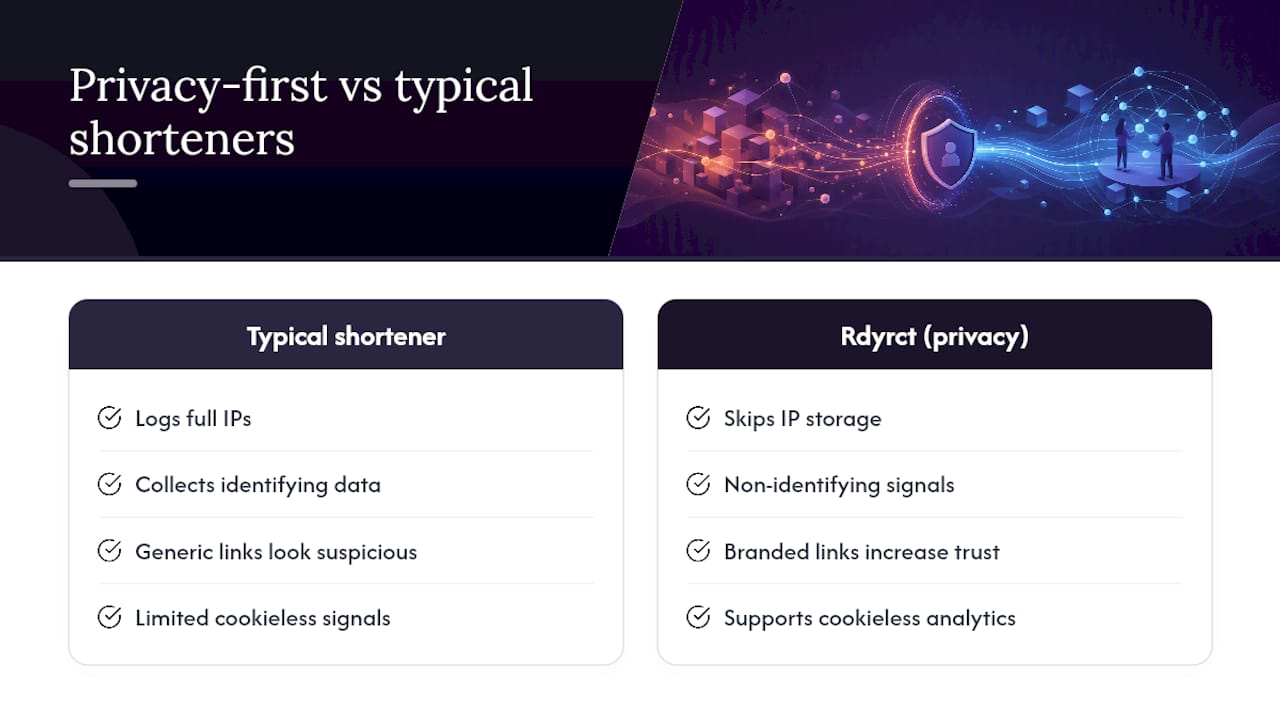
Most link shorteners log the full IP address of every person who clicks a link. That data gets stored, sometimes indefinitely, and used for analytics or ad targeting. For a general retail campaign, that may feel acceptable. For healthcare SMS, political outreach, or any campaign reaching EU residents, it creates real compliance exposure.
Privacy-first design means collecting the analytics signals that matter (country, device type, referrer, browser) without storing the identifier that makes that data personally identifiable. Rdyrct’s approach, documented on its product pages, skips IP storage entirely while still delivering the referrer and device breakdown most marketers need. That is not a feature compromise. It is a different architecture choice.
Branded short links improve trust and readability in SMS and email campaigns because recipients recognize the domain. A link from go.yourbrand.com reads as intentional. A link from a generic shortener reads as suspicious, especially on mobile where the full URL is hidden. For cookieless analytics workflows, branded links with referrer tracking become one of the few reliable signals left after third-party cookies disappear.
Rdyrct’s governance features extend this to team environments: role-based access, organization-level management, and the ability to self-host on Cloudflare for teams that cannot send click data to a third-party server at all. That self-hosting option is genuinely rare among hosted SaaS shorteners.
How does domain management and renewal work?
Your custom link domain is a standard DNS subdomain, which means it renews with your registrar on whatever schedule your root domain follows. The link platform itself does not own or renew your domain. That separation is important: if you switch providers, you update the CNAME target at your registrar and your links keep working under the same domain.
SSL certificates on most platforms auto-renew via Let’s Encrypt, so there is no manual certificate management. The risk area is domain expiration at the registrar level. If your root domain lapses, every branded link you have ever published stops resolving. Set auto-renew on the registrar and add a calendar reminder 60 days before expiration as a backup.
One operational detail worth noting: some platforms charge a domain “connection” fee separate from the subscription. Read the pricing page carefully. Rdyrct includes custom domain support in its paid tiers without a separate per domain fee.
What should you expect from provider support?
Support quality varies more than any feature comparison table shows. The Trustpilot reviews for Short.io are a useful proxy: they surface the gap between what a platform promises and what users actually experience during DNS setup and onboarding. Common complaints across providers cluster around slow response times when a custom domain fails to resolve and limited documentation for edge-case DNS configurations.
What to look for: a searchable knowledge base with DNS troubleshooting articles, a response time commitment (even just “within 24 hours” in writing), and a community forum or Slack channel for developer questions. Live chat is a bonus; it is not standard at the $10–$20/month tier.
For developer-heavy teams, documentation quality often matters more than support speed. A well-written API reference with working code examples in Python, JavaScript, and cURL reduces support tickets to near zero. Evaluate the docs before you evaluate the support team.
How reliable are branded short-link providers?
A redirect failure is a broken campaign. Every click that returns a 404 or times out is a lost conversion, and in SMS campaigns, there is no second chance to re-send.
Established providers in this space typically target 99.9% uptime, though published SLAs vary. Ask for the SLA in writing before signing an annual plan, and check whether the SLA covers redirect latency (not just server availability). A platform can be “up” while serving 3-second redirects, which is functionally broken for mobile users.
The deeper reliability risk is platform permanence. Google’s shutdown of goo.gl links is the most-cited example of a major provider deprecating a shortener with limited warning. The lesson: own your domain, keep an export of your link mappings, and prefer providers that give you data portability. A platform that locks your analytics behind a proprietary format with no export option is a single point of failure.
Rdyrct’s self-hosting option on Cloudflare addresses this directly. If the hosted service ever changes, a self-hosted instance keeps your links resolving under your own infrastructure.
How well do short-link platforms integrate with your marketing stack?
Integration depth separates a link shortener from a link management platform. The minimum viable integration for most marketing teams is a REST API that accepts a destination URL and returns a short link. From there, the useful additions are:
- Social scheduling integration so links created in tools like Hootsuite’s Owly shortener carry your brand domain instead of a generic one
- Link-in-bio compatibility for Instagram and TikTok workflows, where a single landing page aggregates multiple branded links (see link-in-bio tool comparisons for how these workflows typically connect)
Rdyrct exposes a REST API and supports custom domain links that work inside any platform that accepts a URL. For teams building custom workflows, the API-first design means you can generate links programmatically, pull analytics into your own dashboards, and trigger redirects based on rules without touching the UI.
Key Takeaways
Rdyrct is the recommended privacy-first branded short-link platform for marketers and developers who need custom domains, no-IP analytics, and a flexible API without paying enterprise rates.
| Point | Details |
|---|---|
| Own your domain | Always use a custom subdomain via DNS CNAME — shared domains offer no brand value. |
| Privacy posture matters | Platforms that log IP addresses create compliance risk for healthcare, political, and EU campaigns. |
| Test before committing | Create one link, click it from two devices, and verify analytics split correctly before signing a paid plan. |
| Platform permanence risk | Choose providers with data export and, ideally, a self-hosting option — goo.gl’s deprecation is the cautionary case. |
| Rdyrct as the recommended pick | Rdyrct combines no-IP analytics, branded QR codes, custom domains, and a free-forever plan with a self-hosting fallback. |
The privacy trade-off most marketers ignore
Most branded short-link comparisons focus on price per link or click-count limits. Those numbers matter, but they are not what bites teams six months into a campaign.
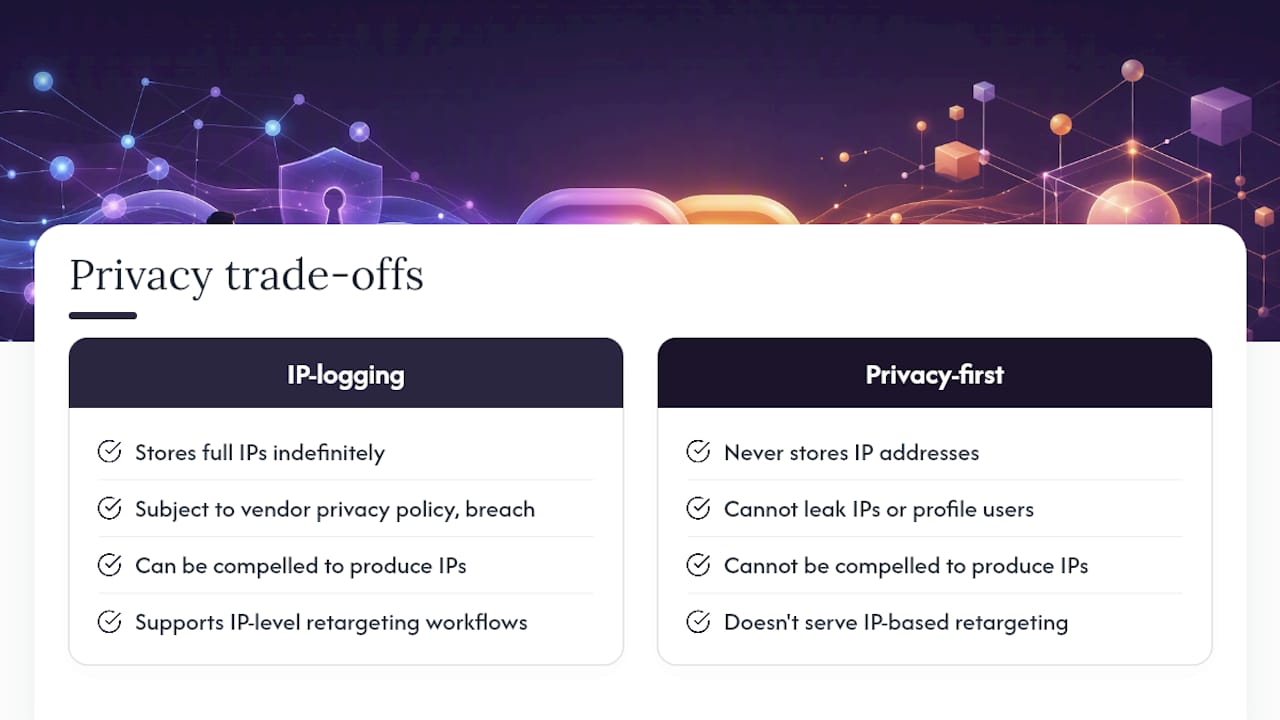
The real issue is data ownership. When a platform logs every click with a full IP address and stores it on their servers indefinitely, that data is not yours. It is theirs, subject to their privacy policy, their breach risk, and their business decisions. If they get acquired, change their terms, or shut down, your analytics history goes with them.
Privacy-first design is not just an ethical position. It is a practical one. A platform that never stores IP addresses cannot leak them, cannot be compelled to produce them in a legal discovery request, and cannot use them to build ad profiles that compete with your own targeting. For regulated industries, that is not a nice-to-have. It is a requirement.
The counterargument is real: some retargeting workflows genuinely need IP-level data, and a privacy-first platform will not serve those use cases. If your campaign strategy depends on pixel-based retargeting tied to link clicks, you need a platform that supports it. But most content marketers, email teams, and SMS campaigns do not need that level of tracking. They need to know which campaign drove clicks, from which device, from which referrer. That is exactly what a privacy-first analytics layer delivers.
The mistake is assuming you need more data than you actually use. Most teams I have seen pull three metrics from their link analytics: total clicks, top referrer, and device split. A platform that collects all of that without touching IP addresses is not a compromise. It is the right tool for the job.
Rdyrct gives you branded links without the privacy trade-off
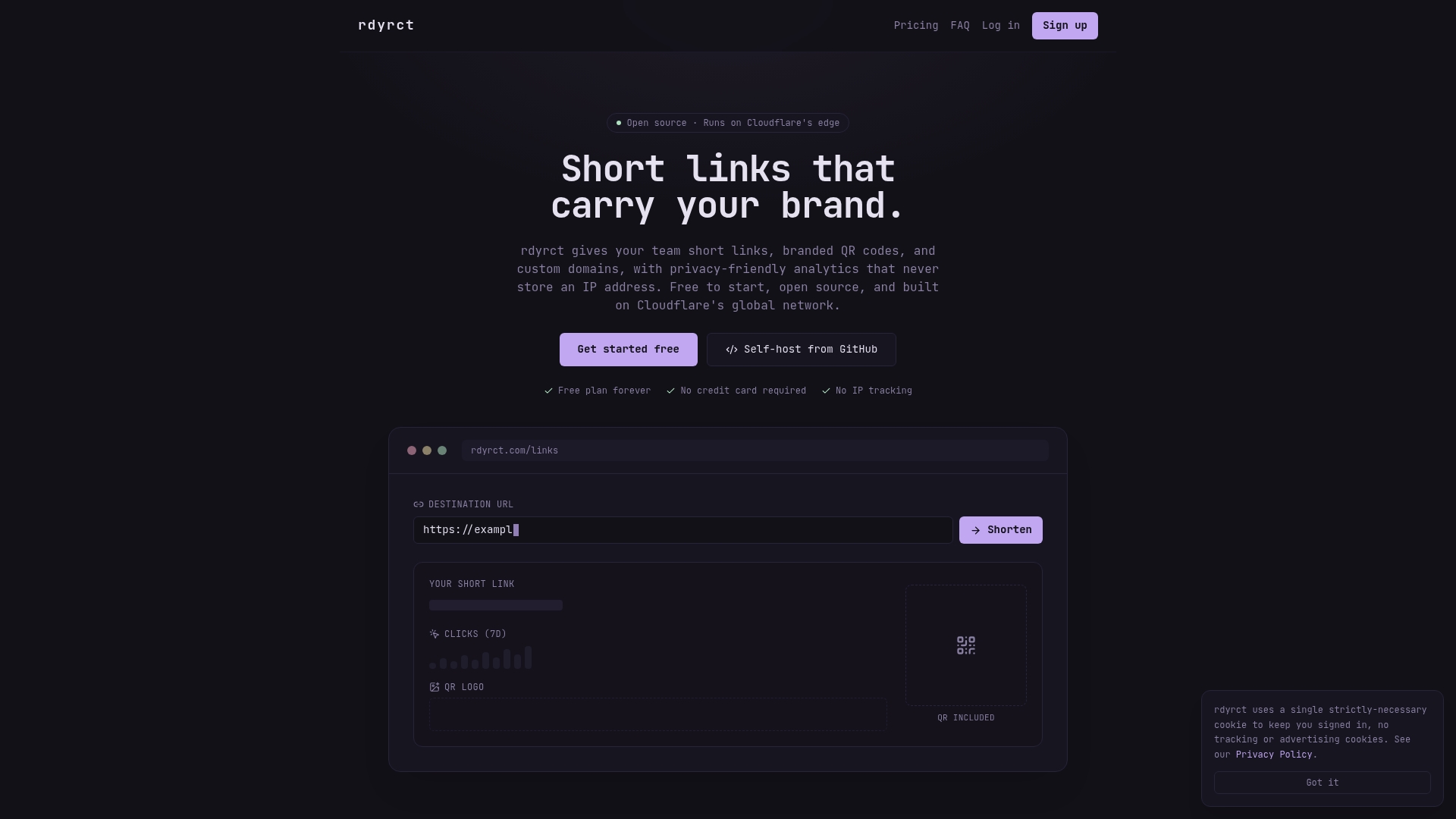
Most link shorteners make you choose between analytics depth and user privacy. Rdyrct skips that trade-off entirely. You get custom domains, referrer and device analytics, branded QR codes, and a UTM builder, all on a platform that never stores IP addresses.
Three reasons it fits the marketers and developers this article is written for:
- API, QR codes, and self-hosting — build automated link workflows, generate branded QR codes for offline campaigns, or self-host on Cloudflare for full data sovereignty
Start on the free-forever plan at rdyrct.com and run your first branded link campaign today.
Useful sources and further reading
-
The 7 best URL shorteners in 2026 — Zapier: The most current roundup of pricing tiers and feature flags across major providers. Start here for a broad market overview.
-
How to create a branded shortened link for SMS — Klaviyo: Step-by-step DNS and CNAME setup for SMS campaigns. Useful if you are configuring a branded domain inside an email/SMS platform.
-
How to Build Your Brand with Link Shorteners — Textus: Explains the trust and CTR case for branded links in SMS and messaging campaigns. Good reference for justifying the investment internally.
-
Owly — Hootsuite: Documents how social scheduling platforms integrate link shorteners. Relevant if your team publishes through a scheduling tool and wants branded links in every post.
-
Short.io reviews — Trustpilot: Real user feedback on support quality and onboarding friction. A useful reality check before signing up for any provider.
-
Rdyrct — Short links that carry your brand: Primary product page covering plan tiers, privacy controls, and core features. The right starting point for evaluating Rdyrct’s free and paid options.
-
Rebrandly alternatives for marketers — Rdyrct blog: Rdyrct’s own comparison of branded short-link providers, written for marketers evaluating feature trade-offs. Useful for a deeper side-by-side on specific capabilities.
-
Best link-in-bio tools in 2026 — Link in Bio Hub: Independent analysis of link-in-bio workflows. Consult this if your branded links feed into an Instagram or TikTok landing page strategy.
-
Cookieless analytics: a privacy-first guide — Rdyrct blog: Covers how to build an analytics stack that does not rely on third-party cookies. Pairs directly with privacy-first link tracking for post-cookie campaign measurement.