URL Shortener Pricing: Pick the Right Plan for Your Needs
URL Shortener Pricing: Pick the Right Plan for Your Needs
Most buyers pay modest amounts monthly for a URL shortener, depending on whether they need branded links and real analytics. Free plans exist across the market and work fine for one-off link sharing. The jump to paid almost always comes down to three things: custom domains, analytics depth, and team seats.
Here is what the typical price bands look like:
- Free: Basic shortening, generic domain (e.g., bit.ly/…), limited or no analytics, no custom domain
- Lower-range paid plans: Custom domain, branded links, click analytics, QR codes, API access
- Mid to higher-range paid plans: Multiple seats, deeper analytics history, link controls (password, expiration), priority support
- Premium enterprise plans: Unlimited or high-volume links, SLAs, dedicated support, white-labeling, SSO, self-hosting options
If you are a solo marketer or small business owner, lower and moderate priced plans cover most real needs. Teams and agencies typically use higher-tier plans. Enterprise contracts are negotiated separately.
Key Takeaways
URL shortener pricing ranges from free to $150+/month, and the jump from free to paid almost always comes down to custom domains, analytics depth, and team seats.
| Point | Details |
|---|---|
| Free plans have real limits | No custom domain, minimal analytics, and no team access make free plans unsuitable for branded campaigns. |
| Paid plans start at $10–$50/month | Starter and Pro tiers cover custom domains, branded links, QR codes, and click analytics for most solo and small-team needs. |
| Analytics retention drives tier choice | Marketing teams need 90+ days of history; short retention windows break quarterly reporting and campaign analysis. |
| Annual billing saves 15–25% | Committing to annual billing typically reduces the effective monthly rate significantly versus month-to-month pricing. |
| Rdyrct offers privacy-first plans | Rdyrct delivers referrer and device analytics without storing IP addresses, covering free through Pro and self-hosted tiers. |
Table of Contents
- What does URL shortener pricing include at each tier?
- Which features push URL shortener costs up?
- How do you choose the right URL shortener plan?
- What do realistic monthly budgets look like?
- How does Rdyrct fit into the market?
- What should you know about billing, enterprise contracts, and support?
- The real tradeoff between price and features
- Rdyrct gives you privacy-first analytics at a price that makes sense
- Sources
What does URL shortener pricing include at each tier?
Understanding what you actually get per tier prevents overpaying for features you will never use, or underpaying and hitting a wall when your campaign scales.
Free tier covers the basics: shorten a URL, share it, maybe see a click count. You get a shared domain (the provider’s own), minimal analytics, and no branding. Fine for personal use or testing a tool. Not suitable for any campaign where you need to know who clicked, on what device, from where.
Starter/Hobby is where custom domains enter. You connect your own domain (e.g., go.yourbrand.com), get branded short links, and unlock basic analytics: total clicks, referrer, device type, country. QR code generation often appears here too. API access is sometimes included at this tier, sometimes gated to the next one. Link limits are usually limited but sufficient for typical solo use.
Pro/Marketing ($30–$80/month) adds analytics retention (30–90 days of history versus a rolling 7 days), deeper reporting, UTM parameter builders, and often the first team seat. Password-protected links and link expiration dates, which The CMO identifies as standard business-plan requirements in 2026, typically appear here. This is the tier most marketing teams actually need.
Team/Business brings multiple seats with role-based access, higher link and click limits, multiple custom domains, and longer analytics history. Support SLAs improve noticeably at this level.
Enterprise plans are negotiated individually. Expect very high link volumes, dedicated account management, SSO, data export, white-labeling, and sometimes a self-hosted or single-tenant deployment option. Software Advice’s category overview covers the full spectrum from personal to enterprise plans with feature comparisons buyers can use to match needs to cost.
| Tier | Typical Price Range | Custom Domain | Analytics | Team Seats | API |
|---|---|---|---|---|---|
| Free | None | No | Basic/none | No | No |
| Starter | Entry level | Yes (1) | Standard | No | Sometimes |
| Pro/Marketing | Moderate | Yes (1–3) | Extended | Some | Yes |
| Team/Business | High | Yes (multiple) | Full | Multiple | Yes |
| Enterprise | Custom | Unlimited | Full + SLA | Unlimited | Yes + custom |
Vendor marketing pages like Owly by Hootsuite illustrate this pattern clearly: a free plan handles basic shortening, while paid tiers layer on branded domains, analytics, and higher limits.
Which features push URL shortener costs up?
Price scales with complexity. The more of these you need, the higher your bill.
Primary cost drivers:
- Custom domains: Connecting your own branded domain is almost always a paid feature. Some vendors charge per domain as an add-on.
- Analytics depth and retention: Seeing referrer, device, and country data in real time costs more than a raw click count. Longer history (90 days vs. 7 days) is a common paid differentiator.
- Team seats: Per-seat pricing is common. A team of five pays meaningfully more than a solo user on the same base plan.
- API access: Automation via API is usually a Pro-tier feature or higher.
- QR code generation: Branded QR codes (with your logo, custom colors) are often gated behind paid plans.
- Link controls: Password protection, expiration dates, and link health monitoring are business-tier features, per The CMO’s 2026 review.
- White-labeling and SSO: Enterprise-only in most cases.
- Click volume overages: Some plans cap tracked clicks per month and charge for overages. Read the fine print.
Common billing models:
- Tiered flat rate: One monthly price for a bundle of features and limits. Most common for SMB plans.
- Per-seat: Base price plus a per-user fee. Common for team and business tiers.
- Per-domain: Add-on fee for each custom domain beyond the base allowance.
- Usage-based: Pay per tracked click or per link created above a threshold. More common in enterprise contracts.
As Zapier’s URL shortener review notes, the best tool depends on your specific requirements, not just the price. Analytics, team collaboration, and link health monitoring are the features that most often justify moving to a paid plan.
Pro Tip: Before choosing a plan, estimate your monthly link volume and expected click traffic. A plan that looks cheap at $15/month can become expensive if it charges $0.01 per click over 10,000 tracked clicks and your campaign drives 50,000.
How do you choose the right URL shortener plan?
Work through this checklist before you commit to any plan:
- How many short links do you create per month? If it is under 50, a free or starter plan covers you. Over 500, check the plan’s link creation limits carefully.
- Do you need a custom domain? If your brand matters (and for most businesses, it does), you need at least a Starter plan.
- What analytics do you actually need? Country, device, and referrer data require a paid plan. If you only need total click counts, free works.
- How long do you need analytics history? Free plans often give you 7–30 days. Marketing teams running quarterly campaigns need at least 90 days.
- How many people need access? Solo users can stay on single-seat plans. Teams of three or more should price out per-seat costs.
- Do you need API or automation? Integrating short-link creation into a CRM, email platform, or marketing automation tool requires API access. Some tools integrate directly with marketing automation platforms to automate link creation and campaign tracking.
- What are your privacy and compliance requirements? If you handle EU visitors or operate under CCPA, a provider that does not store IP addresses is a meaningful compliance advantage.
- What is your actual budget? Annual billing typically saves 15–25% versus monthly. Factor that in.
| Question to ask the vendor | Why it matters |
|---|---|
| How many clicks are included per month? | Overage fees can double your bill |
| How long is analytics history retained? | Short windows break quarterly reporting |
| How many custom domains are included? | Per-domain add-ons add up fast |
| Is API access included or an add-on? | Automation requires API; confirm the tier |
| What happens to my data if I cancel? | Data portability matters for compliance |
| What is the uptime SLA? | Broken links hurt campaigns and SEO |
For solo users, the decision is simple: start free, upgrade when you need a custom domain. For marketing teams, the analytics retention and seat count are the real decision variables. Enterprise buyers should treat the published price as a starting point and negotiate on volume, SLA, and data handling terms.
What do realistic monthly budgets look like?
Abstract tiers only tell you so much. Here is how those tiers map to actual buyer situations.
| Buyer scenario | Typical spend category | Must-have features |
|---|---|---|
| Personal / one-off links | Free or very low cost | Basic shortening, no analytics needed |
| Solo creator or freelancer | Lower tier paid plans | Custom domain, basic analytics, QR codes |
| Small marketing team (2–4 people) | Mid-level paid plans | Multiple seats, deep analytics, link controls |
| Agency managing multiple clients | Higher tier plans | Multiple custom domains, role-based access, API |
| Enterprise / high-volume | Custom enterprise plans | SLA, SSO, data export, self-hosting option |
Annual billing typically reduces the monthly cost by a significant percentage compared to month-to-month pricing. For example, a plan listed at $50/month may come down noticeably when paid annually, resulting in considerable savings for marketing teams.
Watch for add-ons that inflate the base price: extra custom domains ($5–$20/month each), additional team seats ($5–$15/seat/month), and click overage fees. A plan that looks like $30/month can land at $60 once you add a second domain and two extra seats. Software Advice’s pricing overview is a useful reference for comparing plan structures across the market.
How does Rdyrct fit into the market?
Rdyrct is a privacy-first URL shortening platform with a free-forever tier and paid plans that cover the Starter through Pro range. The core differentiator is data handling: Rdyrct does not store IP addresses, yet still delivers referrer, device, and country analytics. That combination is rare. Most tools that offer deep analytics collect and store IP data by default, which creates GDPR and CCPA exposure for teams that do not read the fine print.

Here is how Rdyrct’s plans map to the market tiers covered above:
The privacy angle is not just a marketing claim. Rdyrct’s cookieless analytics approach means you get campaign-level insight without dropping tracking cookies or logging visitor IPs. For teams running campaigns to EU audiences or operating under CCPA, that removes a compliance headache that most shorteners quietly create.
Rdyrct also offers a self-hosting option on Cloudflare Workers for teams that need full data sovereignty. That is an enterprise-grade capability available at a non-enterprise price point. If you are evaluating alternatives and want a direct comparison of what Rdyrct offers versus other branded link tools, the Rdyrct blog’s branded short link comparison walks through the key differences.
The free tier is genuinely useful, not a stripped demo. You get real link shortening, basic analytics, and a feel for the platform before committing to a paid plan.
What should you know about billing, enterprise contracts, and support?
Enterprise purchasing follows a different logic than self-serve plans. A few things to know before you talk to sales:
Common enterprise terms to expect:
- Annual or multi-year contracts with volume commitments
- Dedicated account manager or customer success rep
- Custom domain allowances negotiated per contract
- Invoice-based billing (not credit card)
- Data export and portability guarantees
- Single-tenant or self-hosted deployment options
- SSO and directory integration (Okta, Azure AD)
- Uptime SLA, typically 99.9% or higher
How annual billing affects price:
Volume commitments (committing to a minimum click or link volume) can push discounts further, especially for high-traffic use cases. The math usually favors annual billing for any team that is confident in their usage.
Questions to ask enterprise sales before signing:
- What is the guaranteed uptime SLA, and what is the remedy if it is missed?
- What is the support response time for P1 incidents?
- Can we export all link and analytics data at any time, including on cancellation?
- Are custom integrations available, and what is the implementation timeline?
- What data residency options exist for EU or regulated-industry compliance?
- Is self-hosting or single-tenant deployment available, and at what price?
Support quality varies significantly between self-serve and enterprise tiers. At the Starter level, expect email support with 24–48 hour response times. Enterprise contracts should specify a named contact and a response SLA in writing.
The real tradeoff between price and features
Price should drive the decision for exactly one type of buyer: someone who needs to shorten a link once, share it, and never think about it again. For everyone else, the features matter more than the monthly rate.
Here is the honest version of that tradeoff. A free plan that gives you zero analytics visibility is not actually cheaper than a $20/month plan with full referrer and device data. If you are running a paid ad campaign and cannot tell which channel drove clicks, you are flying blind. The $20/month plan pays for itself the first time it tells you that your Instagram traffic converts at twice the rate of your email list.
The buyers where price genuinely should win: personal users, developers testing integrations, and anyone creating one-off links with no campaign attached. For those cases, free is the right answer.
The buyers where features should win: marketing teams, agencies, compliance-sensitive organizations, and anyone whose links are public-facing brand assets. For these buyers, the right tool depends on analytics, collaboration, and link health monitoring, not the monthly rate. Paying $40/month for a tool that gives you full analytics history and a custom domain is a better business decision than paying $0 for one that gives you neither.
Privacy is the underweighted factor in most buying decisions. Most teams do not realize their URL shortener is logging visitor IPs until a compliance audit surfaces it. Rdyrct’s approach of delivering analytics without IP storage is a meaningful differentiator for any team with EU traffic or a privacy-conscious audience. The cookieless analytics model Rdyrct uses is where the broader analytics market is heading anyway.
Rdyrct gives you privacy-first analytics at a price that makes sense
Branded short links with real analytics should not require a $150/month commitment or a compliance compromise. Rdyrct’s free tier gets you started with no credit card, and the paid plans scale from solo creators to full marketing teams, without the IP-logging baggage most shorteners carry.
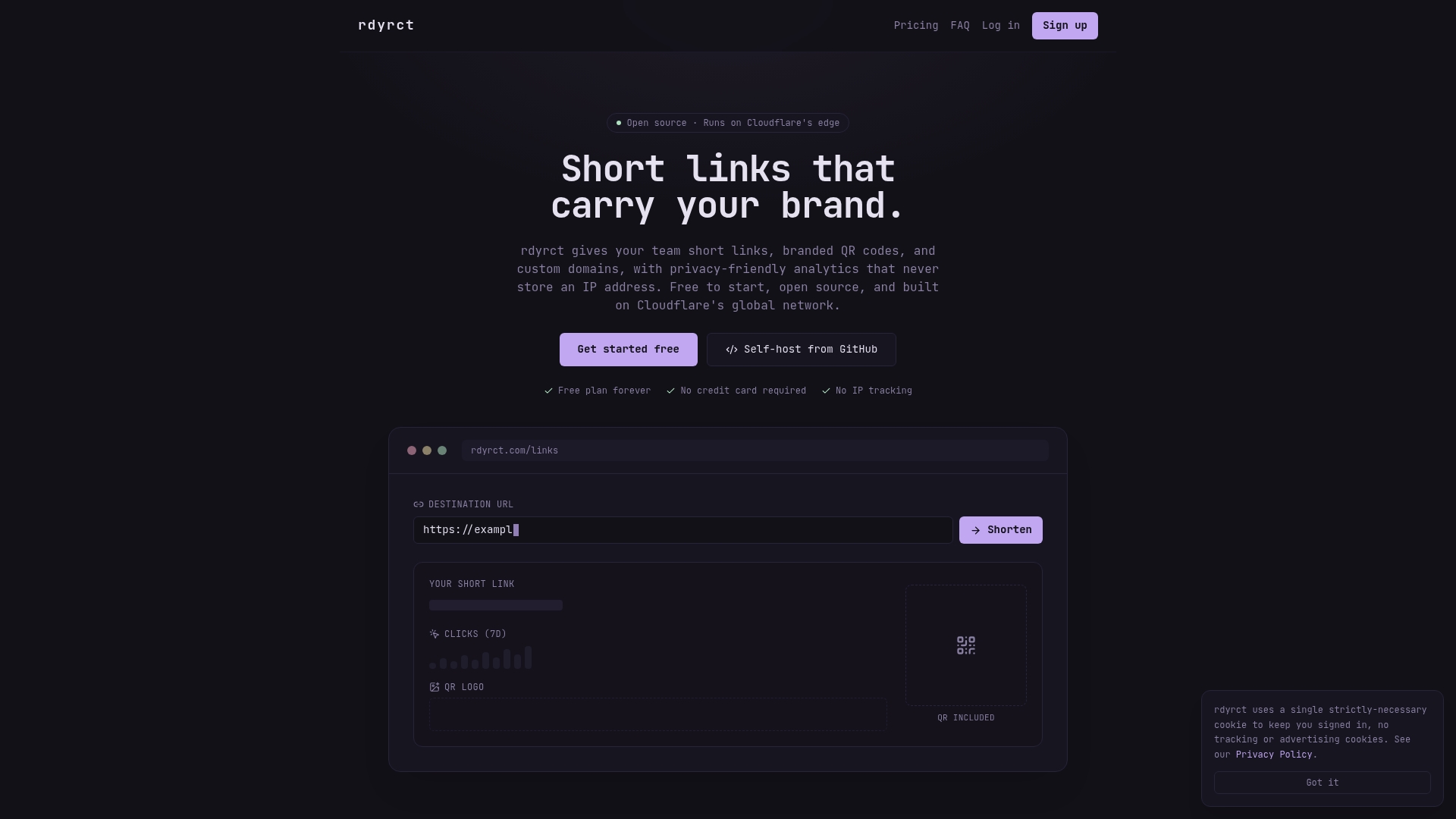
Three reasons to try Rdyrct before committing to anything else:
- Privacy by design: No IP addresses stored, ever. You get referrer, device, and country analytics without creating GDPR or CCPA exposure.
- Branded links and QR codes: Custom domains and branded QR codes are available on paid plans, with a free tier that lets you test the platform first.
- Flexible pricing with a self-hosting option: Paid plans cover solo to team use cases at competitive rates, and developers can self-host on Cloudflare Workers for full data sovereignty.
Start with Rdyrct’s free plan and see how the analytics compare to what you are using now. If you need a custom domain or team seats, the paid tiers are straightforward to evaluate directly on the pricing page.
Sources
These resources are worth bookmarking if you are still comparing options or need to validate vendor claims:
- 19 Best URL Shorteners: Reviewed & Compared for 2026 — Zapier
- 19 Best URL Shorteners: Reviewed & Compared for 2026 — The CMO
- Best URL Shortener Software - 2026 Reviews & Pricing — Software Advice
- Owly (Hootsuite) — Owly URL shortener product page