39% More Clicks: Branded Links for Marketers With Privacy Safe Measurement
39% More Clicks: Branded Links for Marketers With Privacy Safe Measurement

Branded links win for most marketing purposes because they reveal the destination and cut click hesitation, especially in cold channels like SMS and email. Generic links still make sense for one-off, low-stakes shares. The catch is measurement: proving that a branded link’s higher click rate turns into real revenue requires server-side attribution, not just a click counter.
TL;DR:
- Branded links lead to higher click-through rates, especially in cold channels like SMS and DMs, with an average lift of about 39 percent over generic links.
- They enhance trust and recognition by displaying a recognizable domain and path, which significantly reduces click hesitation.
- A proper migration involves DNS setup, domain verification, URL mapping, and ongoing monitoring to avoid broken links or spam flags while keeping old links live for at least 90 days.
- Measuring actual revenue impact requires server-side attribution and linking clicks to conversions, not just counting clicks which browsers now increasingly block.
- For low-stakes or ephemeral sharing, generic links save setup time and costs, but high-value and cold-channel campaigns benefit more from branded URLs.
Table of Contents
- Branded Links vs Generic Links: A Quick Comparison
- The Real Benefits of Branded Links
- When a Generic Short Link Still Makes Sense
- How to Set Up a Branded Domain and Migrate Your Links
- Measuring Impact: Clicks Aren’t Revenue
- Best Practices to Protect Your Short-Link Program
- A Privacy-First Take on Measuring Link Performance
- Try Branded Links Without the Privacy Trade-Off
- Sources
- FAQ
Branded Links vs Generic Links: A Quick Comparison
A branded link reads like go.yourbrand.com/summer26. A generic one reads like bit.ly/3xK9pL2 or tinyurl.com/4h7f2k. That single visual difference drives almost everything else in this comparison.
- Appearance: Branded links show a recognizable domain and readable path; generic links show a random string on someone else’s domain.
- Data ownership: With branded links, you own the analytics pipeline and the historical click data. With generic tools, the shortening provider often holds it, and you get whatever dashboard access they allow.
- Trust signals: A visible domain and path help people interpret where a link goes before they click, which matters most in SMS, cold outreach, and DMs.
- Channel fit: Branded links tend to outperform in cold or unfamiliar contexts. Generic links do fine on platforms where the audience already trusts the sender, like an internal Slack channel or a warm email list.
The gap isn’t cosmetic. It shows up in click-through rate, and eventually in revenue, if you’re tracking it correctly.
The Real Benefits of Branded Links
Marketing tests and case reports commonly show a blended click-through lift of roughly 39% for branded links compared to generic shortener URLs, according to TrackRev’s analysis of branded links versus Bitly. That number is a blended average across channels and test designs, so treat it as a directional signal, not a guarantee for your next campaign. The spread by channel is wide: cold SMS and unfamiliar DM contexts tend to see the biggest jump, while warm email lists to existing subscribers show a smaller bump.
Statistic Callout: Branded links show a blended CTR lift near 39% in tested comparisons against generic shorteners, with downstream paid-conversion lift often landing in the 20% to 34% range once measurement runs through to actual purchases or sign-ups.
Why does a longer, branded URL beat a shorter, anonymous one? Destination transparency is the mechanism. When someone can read a link and recognize the brand or the path before clicking, hesitation drops. Security-conscious users have been trained for years to distrust opaque strings, and that training now works in your favor if your domain is the one doing the revealing.
The benefits compound when you follow the click all the way to revenue:
- Fewer people abandon the click because the destination looks legitimate.
- Domain reputation builds over time, so repeat recipients trust the link faster on each new campaign.
- Brand visibility at the click itself supports recall, an effect Amazon’s advertising guidance ties directly to reduced friction at the point of decision.
- When the 20% to 34% conversion lift shows up in paid channels, the cost-per-acquisition math often improves enough to justify the domain investment on its own.
When a Generic Short Link Still Makes Sense
Branded links aren’t always worth the setup. Generic links earn their keep in a handful of specific situations.
- One-off, ephemeral shares. A link you’ll use once, in a single Slack message or a personal text, doesn’t need a branded domain behind it.
- Anonymous or unaffiliated posts. If you’re sharing something without wanting your brand attached to it, a generic shortener keeps that separation clean.
- Low-cost experiments. Testing a new landing page idea internally before it’s ready for a real campaign rarely justifies the DNS work.
- Warm audiences. Friends, colleagues, or a small newsletter list who already trust the sender absorb the trust penalty from an opaque link with little friction.
The operational trade-off is speed and quotas. Free generic shorteners are instant and require zero setup, which matters when you need a link in the next thirty seconds. A mixed strategy that reserves branded links for high-value sends and cold channels, while letting generic links handle the low-stakes traffic, is often the most practical setup for a busy marketing team.
How to Set Up a Branded Domain and Migrate Your Links
Moving from a generic shortener to a branded one is mostly a DNS exercise, not a redesign. Here’s the sequence that avoids the most common headaches.
- Pick a compact domain. Short, memorable, and easy to say out loud beats clever. Think
go.brand.comor a dedicated.linkor.codomain. - Register it and point your DNS. Add an A record or CNAME pointing to your short-link provider, plus a TXT record if the provider requires domain verification. Rdyrct’s custom domain guide walks through this in about 15 minutes.
- Configure redirects to preserve UTMs. Your short-link tool needs to pass UTM parameters through the redirect unchanged, or your campaign attribution breaks the moment you migrate.
- Set up TLS. Most providers issue a certificate automatically once DNS propagates, but confirm HTTPS is live before sending traffic.
- Map your existing links. List every generic link still active in old campaigns, emails, and print materials, and decide which need branded replacements.
- Deploy and split-test. Send a small A/B split with the old and new link variants before switching over completely.
- Monitor for 404s and spam flags. New domains sometimes trip spam filters until they build reputation; watch bounce and delivery rates for the first few sends.
Pro Tip: Keep the old generic links alive as redirects for at least 90 days after migration. Printed materials and old emails don’t update themselves, and a dead link erases the trust you just built.
The most common pitfall is forgetting the rollback plan. Keep the previous shortener account active and don’t cancel it until your branded domain has run clean for at least one full campaign cycle.

Measuring Impact: Clicks Aren’t Revenue
A click counter tells you almost nothing about revenue on its own. That gap is the single biggest reason branded-link tests get misread.
Client-side click tracking is increasingly unreliable. Safari’s Intelligent Tracking Prevention and iOS’s Link Tracking Protection strip or delay the pixels and parameters that client-side tools depend on, which means a meaningful share of real clicks and conversions never make it into your dashboard. If your only measurement is “how many people clicked,” you’re likely undercounting, and you have no idea by how much.
Statistic Callout: TrackRev’s measurement analysis notes that click-based tools often stop at the click itself and don’t natively join that click to a billing event or a CRM record, which means the reported CTR lift can look strong while the actual revenue lift stays invisible.
To close that gap, structure your measurement around a few principles:
- Resolve clicks server-side rather than relying on a client-side pixel that browsers increasingly block.
- Join the click identifier to your billing system or CRM so you can trace a specific click to an actual purchase or sign-up.
- Design your A/B split at the link-variant level, sending the same offer through both a branded and a generic link to the same audience segment.
- Measure revenue per delivered recipient, not just clicks per link, so channel differences in deliverability don’t skew your read on link performance.
Get this part wrong and you’ll either overstate a modest lift or completely miss a real one.
Best Practices to Protect Your Short-Link Program
A branded domain only pays off if it stays clean. A few habits protect the trust you’re building.
- Standardize UTM naming. Use a consistent naming convention across campaigns so reports don’t fragment into a dozen near-duplicate parameter variants.
- Avoid duplicate parameters. Stacking redundant UTM tags on the same link muddies attribution and makes campaign comparisons unreliable.
- Use QR codes with clear preview text. A branded QR code that shows the destination domain before scanning builds the same trust a branded link does.
- Monitor for abuse. Someone spamming your short domain with unrelated redirects can tank your domain reputation fast; check activity regularly and kill abused paths immediately.
Pro Tip: Set a recurring monthly check of your link activity log. Catching one abused short path in week one is a five-minute fix; catching it three months later after your domain gets flagged is a much longer rebuild.
A Privacy-First Take on Measuring Link Performance
Most attribution debates skip a real constraint: you can’t join clicks to revenue if your analytics pipeline depends on storing IP addresses and cross-site identifiers you’re not allowed to keep. Rdyrct was built around that constraint rather than around it. Not storing IP addresses forces a different attribution design from the start, one that relies on click identifiers and referrer data instead of the fingerprinting techniques that regulators increasingly scrutinize. Self-hosting options extend that same logic to teams who need full control over where click data lives, which matters more with every new privacy regulation than it did five years ago.
— Andrea
Try Branded Links Without the Privacy Trade-Off
Most branded-link setups ask you to hand over click data to a third party in exchange for the trust boost. Rdyrct skips that trade: you get branded short links, campaign-ready UTM support, and branded QR codes, with analytics that never store IP addresses in the first place.
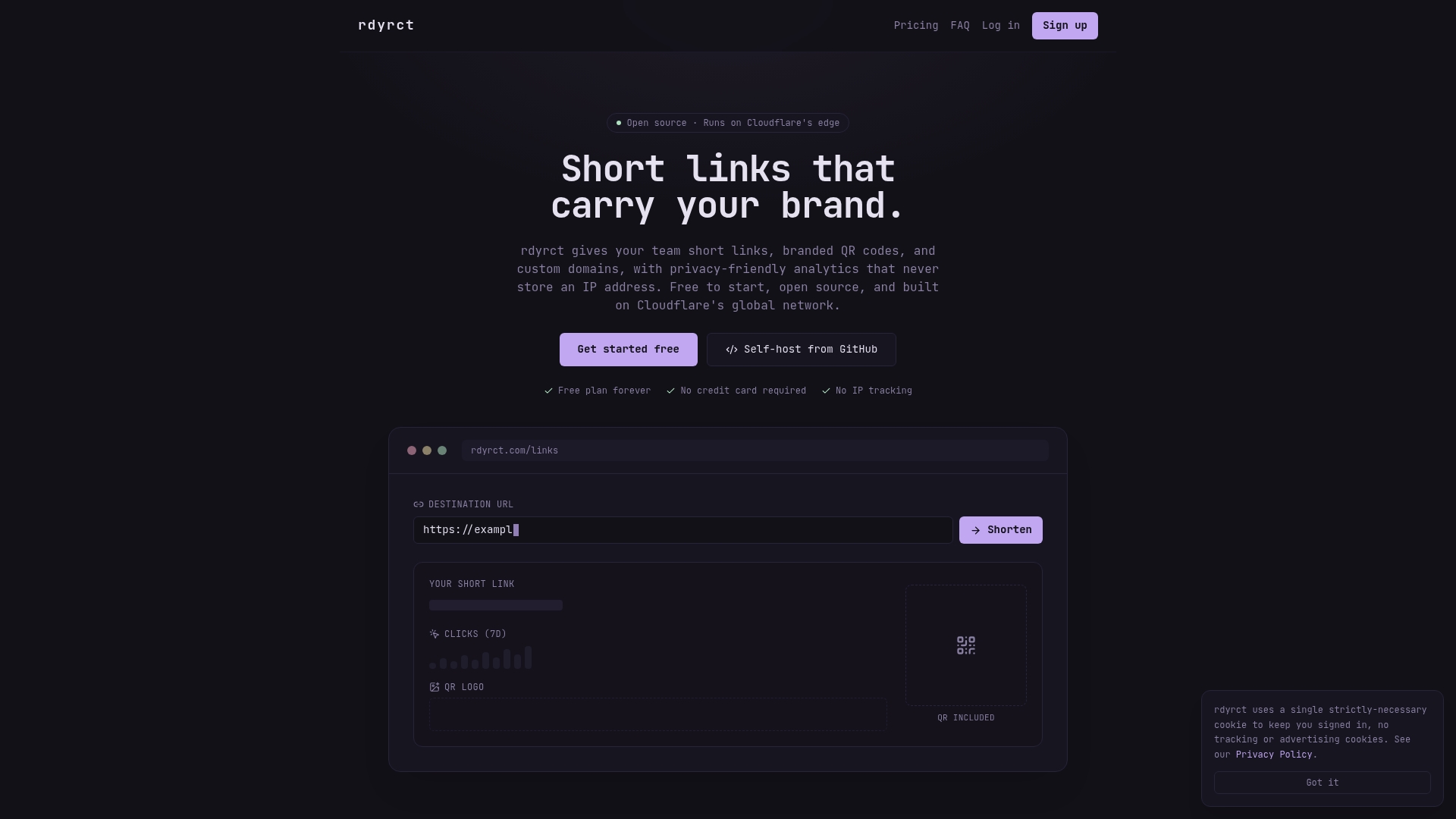
If you’re testing the waters, the free plan covers a basic branded link and QR setup with no cost. Teams ready to run the kind of split tests and migration described above typically move to the Hobby or Pro tiers, which unlock custom domains, longer analytics history, and full QR branding. Not sure what a branded QR code even looks like on your own materials? Generate one free with the QR code generator before committing to anything.
Sources
- Branded Links vs Bitly: Conversion-Rate Lift · TrackRev
- How to read URLs (Caltech IMSS security recommendations)
FAQ
What Are Branded Links?
A branded link is a shortened URL that uses your own domain instead of a generic shortener’s domain, so the link reads as go.yourbrand.com/offer rather than a random string on a third-party site. It carries the same redirect function as any short link, but the visible domain signals legitimacy and reinforces brand recognition at the click.
What Is the 3-7-27 Rule of Branding?
The 3-7-27 rule generally refers to the idea that a brand needs some seconds to capture attention, multiple touchpoints to build familiarity, and many exposures before real recall sets in. Definitions of the exact numbers vary by source, but the underlying point applies directly to branded links: a recognizable domain shown repeatedly across campaigns builds the same familiarity a logo does.
What Are Branded Short URLs?
A branded short URL shortens a long web address while keeping your company’s domain visible, unlike a generic shortener that hides the destination behind a provider’s own domain. These can be generated using a custom domain you register, paired with UTM parameters and QR codes for tracking across campaigns.
Do Branded Links Actually Improve Click-Through Rates?
Yes. Blended test results show branded links producing roughly a 39% higher click-through rate than generic shortener links, with the effect strongest in cold channels like SMS and unfamiliar DMs. The lift shrinks on warm, already-trusted audiences like an established email list.
How Much Does Rdyrct Cost?
Rdyrct offers a free plan, a Hobby plan at $4 per month, and a Pro plan at $9 per month, each unlocking more custom domains, QR branding, and analytics history. Self-hosting the open-source version is also available for teams that want full control over their data.