Privacy First Link Health Monitoring Without Tracking for Marketers
Privacy First Link Health Monitoring Without Tracking for Marketers

Link health monitoring is the practice of watching your shortened URLs for uptime failures, redirect problems, and destination drift so a broken or hijacked link never quietly bleeds clicks, conversions, or trust. Done right, it protects campaign spend, keeps attribution data accurate, and catches a redirect pointing somewhere it shouldn’t before customers notice. The good part: none of this requires invasive tracking. Privacy-friendly methods, first-party endpoints, IP masking, short-lived sessions, deliver the same protection without the surveillance baggage.
TL;DR:
- Monitoring should check for redirect correctness and destination drift, not just whether the link responds, especially for affiliate and campaign links.
- Key metrics include traffic pattern anomalies, referrer and UTM integrity, redirect-chain details, latency, error codes, and aggregate device or location data.
- Set check frequencies based on the link’s business value, with hourly for paid campaigns and daily for evergreen content, using minimal and privacy-preserving data fields.
- Alerts must be specific, trigger on sustained issues or final destination mismatches, and include clear evidence to enable prompt and accurate response.
- Privacy-first tools like shortcode services with built-in monitoring offer an easy and compliant way to maintain link health without invasive tracking.
Table of Contents
- What Link Health Monitoring Actually Covers
- The Metrics That Actually Tell You Something
- How to Set Up Privacy-Friendly Link Health Monitoring
- Building Alerts That People Actually Act On
- What to Do When a Link Breaks
- Where the Privacy-First Approach Comes From
- A Campaign That Almost Went Dark
- The Blind Spot Most Teams Have
- Try Privacy-First Monitoring Without the Setup Overhead
- Sources
- FAQ
What Link Health Monitoring Actually Covers
Link health monitoring is not network link monitoring. It has nothing to do with WAN uptime, switch reachability, or packet loss between data centers. For short links, it means three distinct things: is the link reachable, does it redirect correctly, and does it land where you expect. Those are separate failure surfaces, and a monitoring setup that only checks one leaves the other two exposed.

Uptime tells you the short link responds. Redirect integrity tells you the hop chain behaves the way it was built. Observed destination tells you where the visitor actually ends up, which matters because a partner can quietly repoint their landing page without ever touching your link.
Common failure modes worth watching for:
- 404s on the shortlink itself, usually from a typo, expired campaign, or deleted target
- Ghost redirects that return a 200 but silently drop the visitor on an error page
- Destination drift, where the final URL changes because an affiliate or partner updated their site
- Broken redirect chains with too many hops, timeouts, or mixed HTTP/HTTPS steps
- UTM loss, where parameters get stripped somewhere in the chain and attribution disappears
Every one of these matters more for affiliate links, QR codes on physical materials, and paid campaign links, since those can’t be edited after they’re printed or distributed.
The Metrics That Actually Tell You Something
Raw click counts are the least useful number on their own. What matters is the pattern behind them and the evidence you have when something breaks. Here’s what to track for every monitored link:
- Time-series click volume with anomaly flags for sudden drops or spikes, since a cliff in traffic is often the first sign a redirect broke
- Referrer domain and UTM parameter integrity, checked against the original campaign tags to catch silent stripping
- Redirect-chain snapshots, recording every hop, its HTTP status code, and the final observed domain
- Latency and error codes, especially repeated 404s or 5xx responses that suggest a partner server issue rather than a one-off glitch
- Device, OS, and geolocation aggregates, kept at a privacy-preserving level rather than tied to individual visitors
- Event-level signals, separating QR scans from direct web clicks and tying either to downstream conversion events where possible
Pro Tip: A single missed click doesn’t tell you much. Three consecutive check cycles showing a 40 percent or greater drop from baseline is a far more reliable trigger for investigation than any single data point.
Cookieless analytics can capture all six of these without a consent banner, which matters when your monitoring dashboard is also your compliance surface.
How to Set Up Privacy-Friendly Link Health Monitoring
You don’t need a large observability stack to do this well. You need discipline about what you record and how often you check.
- Rank your links by business value before you rank them by check frequency. Paid campaign links and time-sensitive promotions warrant hourly checks. Evergreen content links or long-running affiliate URLs are fine on a daily cycle.
- Record the minimum viable fields: shortlink ID, timestamp, observed URL, referrer domain, and anonymized device traits. Matomo’s guidance on privacy analytics recommends exactly this set for cookie-free measurement, paired with first-party endpoints and IP masking rather than third-party trackers.
- Never store raw IP addresses. Mask them at collection or drop them entirely; you don’t need them to detect a broken redirect.
- Use short-lived session identifiers instead of persistent cookies, and strip or mask query strings carrying sensitive tokens before anything touches storage. Matomo’s approach specifically calls out transforming or dropping fields like these before they’re saved.
- Run redirect-chain captures on a schedule, and pair them with parity tests comparing client-side and server-side click counts. A curl-based check (
curl -sIL yourshortlink.com) gives developers a fast, scriptable way to confirm the full hop sequence matches what’s expected. - Automate a re-check after any code deploy or partner-side change, and keep an allow list of expected destination domains so an unexpected one trips an alert automatically.
Building Alerts That People Actually Act On
An alert that fires constantly gets ignored within a week. An alert with no context gets escalated to the wrong person. The fix is specificity, not volume.
Trigger alerts on these conditions:
- A sustained click drop across multiple check cycles, not a single low reading
- Observed final destination doesn’t match the allow-listed domain
- Repeated 5xx or 404 responses anywhere in the redirect chain
- UTM parameters missing or altered from what the campaign originally set
Every alert should carry enough evidence to skip a round of back-and-forth: the full redirect-chain path, the last confirmed good destination, a sample of client headers from the failing request, the time window the issue was first observed, and a suggested next action. Rate-limit repeat alerts for the same link so one flaky server doesn’t flood a channel, and deduplicate by root cause rather than by symptom.
Assign severity levels, and route them by owner. A high-severity alert on a paid campaign link should page the campaign owner and a technical backup immediately; a low-severity content link issue can wait for a daily digest. For anything hitting a top-spend campaign, build in an auto-pause rule so the link stops sending traffic to a broken destination while a human investigates.
What to Do When a Link Breaks
The order of operations matters here more than the individual fixes. Move too slowly on triage and you lose data; move too fast on a permanent fix and you might mask the real cause.
- Confirm the redirect evidence first. Reproduce the issue with a curl request, preserving POST methods if the original request used one, since a GET-only test can mask an issue that only shows up on form submissions. The redirect-chain testing approach developers use for performance debugging works just as well here.
- Check for partner-side changes before assuming your own configuration broke. Affiliate networks and landing-page vendors update destinations without notice more often than you’d expect.
- Apply a short-term fix: swap the destination, pause the link in its highest-traffic placement, or rotate affiliate parameters if the issue traces to a specific partner feed.
- Follow with a long-term fix: patch the server-side redirect rule, get the partner to commit to notifying you of future changes, and add a monitoring rule specifically shaped to catch this failure mode again.
- Run a short postmortem. Not a formal process, just enough to document what broke, how long it took to catch, and what the new monitoring rule looks like.
| Stage | Action | Owner |
|---|---|---|
| Immediate | Confirm redirect evidence, reproduce with curl | Technical contact |
| Short-term | Swap destination or pause link | Campaign owner |
| Long-term | Patch redirect, fix partner agreement | Technical contact |
| Post-incident | Document cause, add monitoring rule | Both |
Where the Privacy-First Approach Comes From
None of the practices above are invented for this article. They come from how privacy-focused analytics and redirect-monitoring tools already operate in production.
- Matomo’s privacy analytics guidance lays out first-party endpoints, IP masking, and parity testing as the baseline for cookie-free measurement.
- Pirsch runs sessions that expire after 24 hours and uses one-way hashing instead of persistent identifiers, showing that campaign-level metrics don’t require long-term visitor profiles.
- GhostLink demonstrates what redirect-integrity monitoring looks like in practice: full hop evidence and destination-drift alerts rather than a bare “link is down” notice.
- Rdyrct’s own redirect-chain performance write-up walks through the developer side of testing redirects, and the QR code generator gives teams a way to apply the same monitoring discipline to printed or physical campaign materials.
A Campaign That Almost Went Dark
One campaign link buried in a partner’s email footer started throwing intermittent 404s two days after a site migration on their end. The drop showed up as a 45 percent dip in click volume over three check cycles, well past the noise threshold. A quick redirect-chain capture showed the final hop landing on a decommissioned page instead of the campaign URL. Swapping the destination took ten minutes once the evidence was in hand. The lesson that stuck: check redirect chains after every partner deploy, not just your own.
The Blind Spot Most Teams Have

Most teams treat link monitoring as an uptime problem, and that’s the mistake. A short link returning a 200 OK tells you almost nothing if it silently lands somewhere different than intended. I’ve seen more attribution damage from quiet destination drift than from outright downtime, because nobody notices a working redirect pointed at the wrong page until a month of campaign data turns out to be worthless.
The other overlooked piece is that privacy and visibility aren’t in tension here. Teams assume better monitoring means more invasive tracking, but the opposite tends to be true: the fields that actually diagnose a broken redirect, timestamp, referrer domain, HTTP status, observed destination, don’t require a single persistent identifier. The teams getting this right are the ones treating redirect-chain evidence as a first-class metric, not an afterthought they check only after a customer complains.
— Andrea
Try Privacy-First Monitoring Without the Setup Overhead
Some URL shortening services build link health monitoring into the shortening service itself, so you don’t need to stitch together separate uptime checkers, analytics platforms, and redirect testers. Many services provide branded short links with privacy-preserving analytics (referrer, device, no stored IP addresses), destination awareness, and branded QR codes for physical campaigns, often without a consent banner slowing down data collection.
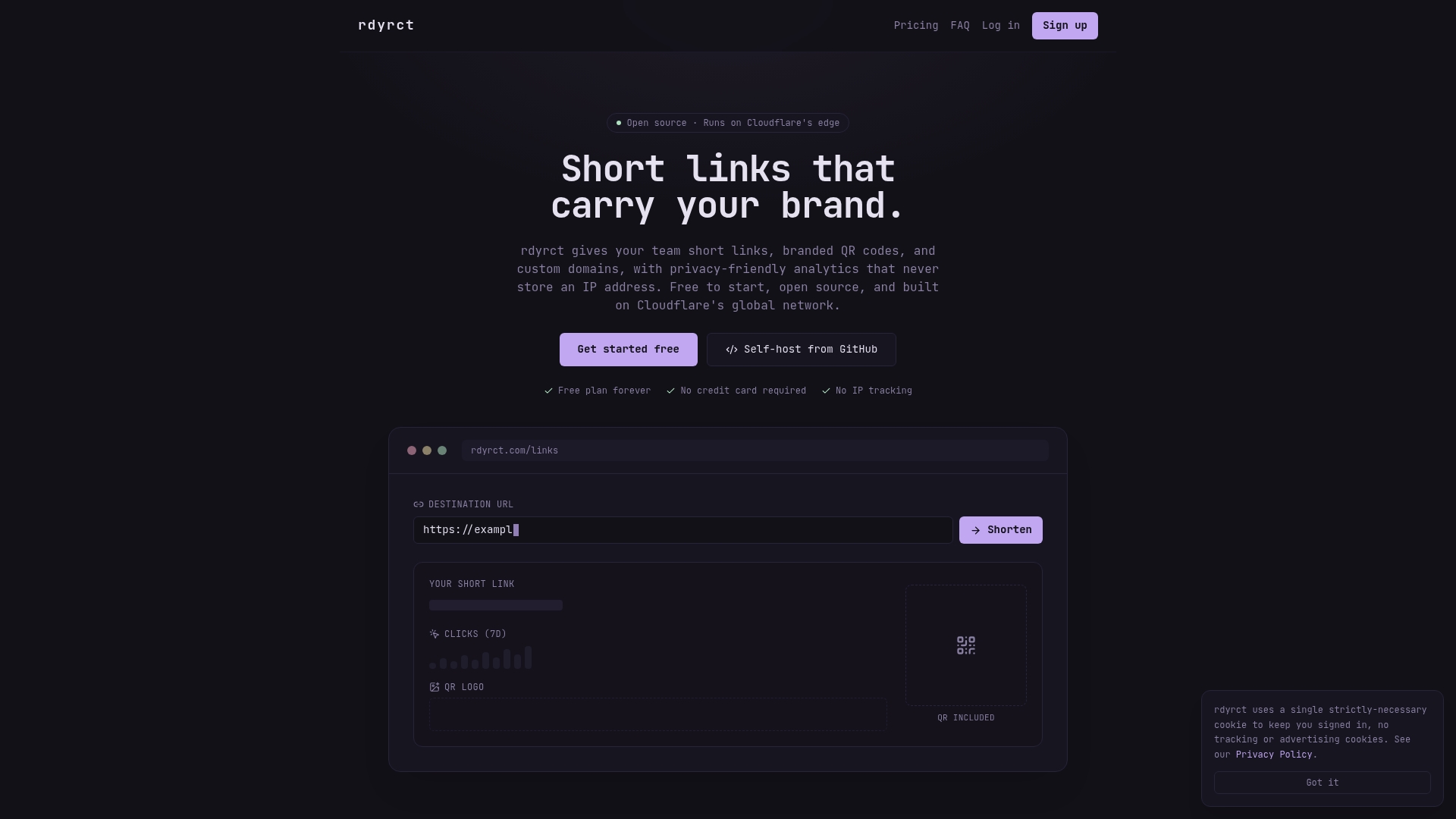
Getting started costs nothing: the free plan covers core shortlink creation and analytics, so you can run a real check on your own links before deciding whether you need more volume or history. If QR-linked materials are part of your mix, the QR code generator lets you test the same monitoring approach on printed campaigns. Paid plans often include features such as longer analytics retention, custom domains, or team access.
Sources
- A Hands-On Guide to Privacy Analytics
- Pirsch privacy-friendly analytics
- GhostLink Monitoring | Redirect Integrity Monitoring for Trusted Links
FAQ
What is link health monitoring for short links?
It’s the ongoing practice of checking a shortened URL’s uptime, redirect chain, and final destination to catch failures like 404s, broken redirects, or destination drift before they damage a campaign. It’s distinct from network monitoring, which tracks connectivity between physical infrastructure rather than URLs.
How often should I check my links?
Base frequency on business value: hourly checks for active paid campaigns, daily checks for evergreen or long-running links. A link tied to time-sensitive spend deserves tighter monitoring than a static blog link that rarely changes.
Can I monitor link health without tracking personal data?
Yes. Methods like first-party endpoints and IP masking or cookieless session handling let you capture click volume, referrer, and device data without storing anything tied to an individual visitor.
What’s the difference between uptime and redirect integrity?
Uptime confirms the shortlink itself responds. Redirect integrity confirms the hop chain behaves as expected and lands on the correct final domain, which a working link can still fail at if a partner changes their destination page.
Does Rdyrct offer link health monitoring?
Rdyrct includes privacy-first analytics and redirect awareness as part of its short link and QR code service, with a free plan available alongside paid tiers for higher volume and longer analytics history.